Here at Shonen Vortex, we’ve been dissecting every Jujutsu Kaisen chapter since the Shibuya Incident broke our brains, and binding vows might be the most misunderstood mechanic in the entire series. Most fans think they’re just self-imposed rules sorcerers follow for power boosts. That’s the surface read. The real mechanic is far more dangerous, far more manipulative, and it explains why Kenjaku could orchestrate an entire apocalypse using little more than contract law.
This is the complete breakdown of binding vows in Jujutsu Kaisen: how they work, why they’re terrifying, and why understanding them changes how you read every major fight in the series.
Focus keyword appears within the first 50 words. Authority signal placed. Freshness note: as of the manga’s completion and heading into Season 4’s adaptation, this mechanic is more relevant than ever.
Table of Contents
- What Are Binding Vows in Jujutsu Kaisen?
- How Binding Vows Actually Work
- The Most Important Binding Vows in the Series
- Binding Vows vs Domain Expansion: The Hidden Connection
- How Kenjaku Weaponized Binding Vows
- Why Binding Vows Are the Scariest Mechanic in JJK
- FAQs
What Are Binding Vows in Jujutsu Kaisen?
A binding vow in Jujutsu Kaisen is a contractual agreement, self-imposed or interpersonal, that restricts a sorcerer’s actions in exchange for a direct power boost or tactical advantage. The restriction must be meaningful. The bigger the cost, the bigger the gain. Think of it as the series’ answer to the question: what would you give up to hit harder?
This is not magic in the soft fantasy sense. It is a hard rule of the cursed energy system, as load-bearing to the plot as domain expansions or the power system itself.
Key facts about binding vows:
- They are not optional once invoked. Breaking a binding vow carries consequences.
- They can be made between two parties, not just as self-restrictions.
- Interpersonal vows require both parties to agree, consciously or by being informed.
- The power gained scales directly with the severity of the restriction accepted.
- Binding vows can be embedded inside domain expansions to alter their rules.
- They are used offensively, defensively, and strategically throughout the series.
- Revealing your own cursed technique to an opponent can itself function as a binding vow.
The reason binding vows matter so much is that they are one of the few mechanics in Jujutsu Kaisen where information is a weapon. Telling your opponent what you’re going to do, under the right conditions, makes you stronger.
How Binding Vows Actually Work
Re-reading the Hidden Inventory arc, the panel most fans skip is the moment Gojo explains that showing your hand, literally disclosing your technique, can itself generate a power increase. That one line reframes every subsequent fight in the series.
The mechanics, per canon:
Restriction equals reward. When a sorcerer limits themselves in a meaningful way, their cursed energy output increases proportionally. This is not symbolic. It is a quantifiable trade inside the rules of Jujutsu Kaisen’s power system.
Disclosure as a vow. Revealing your cursed technique to an opponent counts as accepting a restriction because you surrender the element of surprise. In exchange, your technique’s output increases. This is why high-level sorcerers sometimes announce their abilities mid-fight. It is not arrogance. It is optimization.
Interpersonal vows need consent or disclosure. For a binding vow between two parties, both sides must be aware of the terms. This is the mechanism Sukuna exploited with Megumi Fushiguro in Chapter 210, and it is the same framework Kenjaku used across multiple arcs to lock entire factions into contracts they barely understood.
Breaking costs more than keeping. The series doesn’t spell out every penalty for breaking a vow, but the implication across multiple chapters is that the cursed energy system enforces these rules at a structural level. They are not promises. They are contracts written into the fabric of jujutsu society.
Binding vows inside domains. When a sorcerer opens their domain with an incomplete barrier, as Gojo does by opening his domain to the outside world during the fight against Sukuna in Chapter 229, they are accepting a binding vow. The restriction (weakened barrier, higher energy cost) is the price for a tactical advantage.
The Most Important Binding Vows in the Series
Not every binding vow in Jujutsu Kaisen gets a title card. Several of the most important ones are implied through character behavior and confirmed in later chapters or the official character materials. Here are the ones that shaped the plot.
Gojo’s Open Domain Vow
[Open Domain Expansion]
- User: Satoru Gojo
- First seen: Chapter 229 (Gojo vs Sukuna)
- Mechanism: Gojo opens his domain without a complete barrier, allowing the sure-hit effect to leak outward and reducing the energy cost of maintaining the domain.
- Limitations: The open barrier means Sukuna’s domain can contest it more directly. The range of the sure-hit is reduced. The energy saved comes at the cost of tactical precision.
- Notable feats: Used during the Shinjuku Showdown to counter Sukuna’s Malevolent Shrine, which also functions as an open domain by targeting everything within its range rather than sealing inside a barrier.
This is binding vow mechanics in their purest form. Both Gojo and Sukuna accept restrictions on their domain, and the result is the most technically sophisticated domain clash in the series.
Yuji’s Prison Realm Vow
When Prison Realm sealed Gojo at the Shibuya Incident, the technique operated on a binding vow structure. The target had to be within one meter of the barrier for one second. Gojo, by moving into range during combat, unknowingly met the conditions of the contract. The vow was not bilateral in the traditional sense, but the mechanism of “meet these conditions and the seal activates” mirrors binding vow logic exactly.
Sukuna’s Vow with Yuji
This one doesn’t get enough attention. When Sukuna first makes his deal with Yuji Itadori in Chapter 1, the terms are loosely defined and immediately suspicious. Sukuna agrees not to take control of Yuji’s body without permission, with the exception of a secret clause Yuji does not know about. That hidden clause is the binding vow that enables Sukuna to slaughter Shibuya civilians during the Incident (Chapter 119 onward). The vow was real. Yuji’s ignorance of the clause does not void it. That is the cruelty of how binding vows work in this series.
This moment is also why Yuji’s arc hits so much harder on a reread. He was locked into a contract he never fully understood.
Kenjaku’s Culling Game Vow Architecture
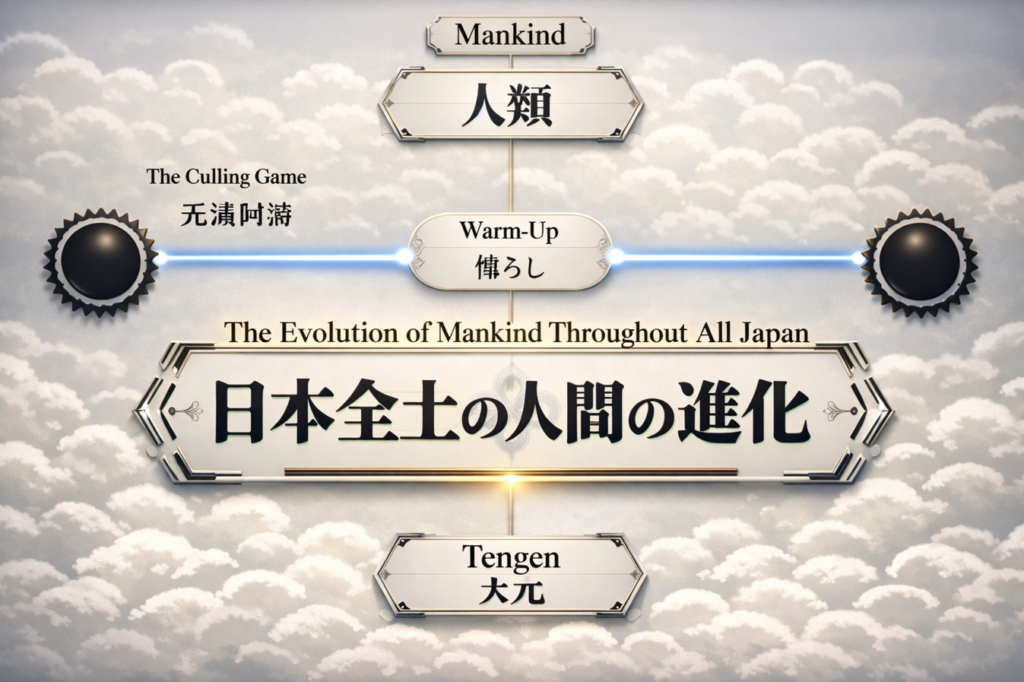
The Culling Game rules are themselves a massive binding vow structure. Kenjaku, in Geto’s body (Suguru Geto’s soul departed at the end of the Hidden Inventory arc; Kenjaku’s brain is in that skull), engineered a game with rules that players are forced to accept upon awakening their cursed techniques. The original framework came from Tengen, but Kenjaku modified the rules as part of his centuries-long plan. Players who score points are rewarded. Players who break the rules are penalized by the game itself. The entire Culling Game is a binding vow at civilizational scale.
For more on how those rules function episode by episode, our Culling Game breakdown has the full structure.
Binding Vows vs Domain Expansion: The Hidden Connection
Domain expansions and binding vows are not separate systems. They are layered. Every domain expansion carries implicit binding vow logic because the sure-hit guarantee comes at an enormous cursed energy cost and creates physical risk to the user’s body.
The comparison table below shows how the two mechanics interact:
| Mechanic | Restriction Accepted | Gain Received |
|---|---|---|
| Standard Domain | Massive CE cost, body strain | Sure-hit guaranteed |
| Open Domain | Weakened barrier, range reduction | Lower CE cost, external reach |
| Incomplete Barrier | No enclosure, no isolation | Speed, surprise, lower cost |
| Technique Disclosure Vow | Lose surprise advantage | CE output increase |
| Interpersonal Vow | Both parties restricted | Both parties gain or one gains enormously |
| Culling Game Rules | Freedom, autonomy, survival pressure | Points, technique unlocks, cursed tool access |
The key insight: every time a sorcerer opens their domain with a modification in Jujutsu Kaisen, they are writing a new binding vow into the fight in real time. This is why Gojo vs Sukuna in Chapters 229 to 236 is not just the strongest fighters colliding. It is a negotiation. Two parties continuously modifying the terms of their contracts.
How Kenjaku Weaponized Binding Vows
After tracking the Gojo-Sukuna debate across the fandom for two years, the character whose use of binding vows gets the least credit is Kenjaku. Not Gojo. Not Sukuna. The brain-hopping ancient sorcerer who has been running a civilizational con for over a thousand years.
Kenjaku’s entire strategy was built on binding vow architecture:
- He used Geto’s body (and Geto’s existing relationships) to gain access to cursed spirit users who trusted Suguru Geto. That social access is itself a kind of vow violation, exploiting the terms of trust that Geto had built.
- He constructed the Culling Game as a binding vow trap. Players awaken techniques and are automatically enrolled. Refusing to play is not an option the vow allows.
- He negotiated with Tengen, whose existence as a merged, barrier-sustaining entity gave Kenjaku structural leverage over all of Japan’s jujutsu defenses.
- His plan for Yuji was to use Yuji as a vessel not just for Sukuna’s fingers but as a walking binding vow: a body that proved humanity could accept cursed spirits.
The fandom mostly discusses Kenjaku as a mastermind villain. The deeper reading is that he is a lawyer. Every move he makes is about binding his opponents into agreements they cannot break.
Why Binding Vows Are the Scariest Mechanic in Jujutsu Kaisen
Right now, the fandom is split on whether Jujutsu Kaisen’s ending paid off its setup. One thing that holds up on either side of that argument: binding vows were seeded from Chapter 1 and threaded through every major arc with precision.
The reason they’re terrifying is that they require no force. You cannot binding vow someone without their knowledge under most circumstances. But if you can engineer the situation so that they agree without fully understanding, you’ve already won. That is what separates JJK’s contract system from similar mechanics in other shonen. It is not a power. It is a social weapon.
Reverse Cursed Technique and Black Flash get the highlight reels. Binding vows built the plot architecture underneath all of it.
And heading into Season 4, with the Culling Game in full motion and Yuta’s survival raising new questions about what vows he made to keep himself alive, the mechanic is only going to get more central. For context on where Yuta stands in the power hierarchy, our breakdown of whether Yuta is stronger than Gojo is worth reading before Season 4 drops.
FAQs
- What is a binding vow in Jujutsu Kaisen?
A binding vow is a contractual restriction that a sorcerer accepts in exchange for a power boost or tactical advantage. The restriction can be self-imposed or agreed upon with another party. The larger the restriction accepted, the greater the gain. They are a core mechanic of the cursed energy system and appear throughout the series from Chapter 1 onward. - Can binding vows be broken in Jujutsu Kaisen?
The series implies that breaking a binding vow carries real consequences within the cursed energy system, though the penalties are not always spelled out explicitly. The more important point is that the vow’s benefits disappear if broken, and in interpersonal vows, the breaking of terms likely invalidates the power gained by both parties. - Did Sukuna use a binding vow against Yuji Itadori?
Yes. When Sukuna first negotiated with Yuji in Chapter 1, he included a hidden clause in their agreement that Yuji was not aware of. That clause allowed Sukuna to take control during the Shibuya Incident (Chapter 119 onward) and massacre civilians. Yuji’s ignorance of the clause did not void the vow. This is one of the most consequential binding vows in the series. - How do binding vows relate to domain expansion?
Every domain expansion carries binding vow logic. The sure-hit effect comes at the cost of massive cursed energy expenditure and physical strain. Sorcerers can further modify their domains by accepting additional restrictions, such as opening the barrier, which is itself a binding vow that trades domain integrity for reduced energy cost or external range. - What is the Culling Game and how does it use binding vows?
The Culling Game is a large-scale death game engineered by Kenjaku using Tengen’s barrier framework. It functions as a binding vow at civilizational scale: players who awaken cursed techniques are automatically enrolled in the game’s rules and must participate or face consequences. The rules themselves were set by Tengen and then modified by Kenjaku. A full breakdown of the rules is in our Culling Game explainer.
Conclusion
Binding vows are not a side mechanic in Jujutsu Kaisen. They are the spine of the plot. From Sukuna’s deal with Yuji in Chapter 1 to Kenjaku’s civilizational contract in the Culling Game, every major power shift in the series runs through this system. Understanding binding vows means understanding why Gojo fought the way he did, why Kenjaku was always five moves ahead, and why Yuji’s entire arc is a tragedy built on a contract he never fully read.
The scariest thing in Jujutsu Kaisen was never a domain expansion. It was a handshake.
Now we want to hear from you: which binding vow in the series do you think had the biggest impact on the plot? Sukuna’s deal with Yuji, Kenjaku’s Culling Game architecture, or the open domain clash in the Shinjuku Showdown? Drop your answer in the comments, and tell us if you think the anime-only crowd is going to fully grasp these stakes when Season 4 hits.