Lobotomy Kaisen took over the internet before most fans even understood what it meant. Here at Shonen Vortex, we’ve been tracking every meme wave since the Shibuya Incident broke the fandom in half, and nothing hit quite like this. The phrase started as a joke about how unhinged Jujutsu Kaisen’s plot had become, and it became one of the most searched anime terms of 2024. This article documents the full evolutionary arc of the phenomenon, something no other anime site has mapped properly. As of May 2026, the meme is still alive, and that tells you everything about what Gege Akutami actually built.
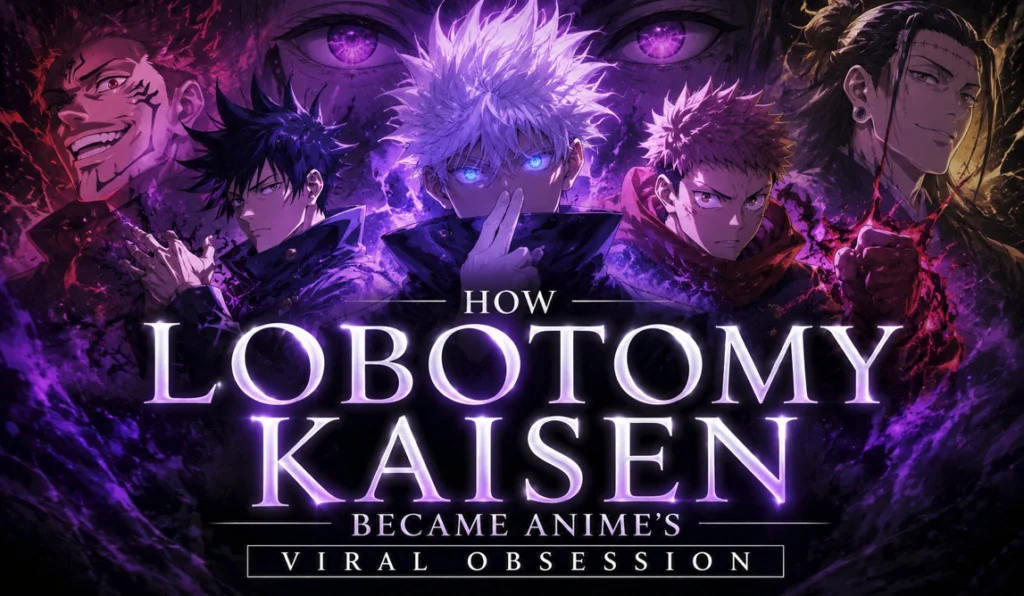
Table of Contents
- What Is Lobotomy Kaisen?
- How Brainrot Culture Saved JJK Fandom Engagement
- The Meme Evolution After Gojo’s Death
- Agenda Posting and Irony Communities
- How Jujutsu Kaisen Changed Anime Internet Humor Forever
- Lobotomy Kaisen FAQs:
- Conclusion
What Is Lobotomy Kaisen?
Lobotomy Kaisen is the fan-coined nickname for Jujutsu Kaisen during its most chaotic narrative stretch, roughly Chapter 221 through Chapter 271. The term captures the feeling that following the manga required you to surgically remove the part of your brain that demands logical storytelling. It is not an insult. It is a badge of honor.
The label exploded across X (formerly Twitter), Reddit, and TikTok after the Gojo vs. Sukuna fight in Chapter 236. That chapter killed the most popular character in the series with no resurrection, no goodbye, and no warning. Fans did not respond with grief alone. They responded with chaos, and the internet loved every second of it.
What made Lobotomy Kaisen different from other anime memes:
- It emerged from genuine narrative disorientation, not just hype
- It united manga readers and anime fans in shared bewilderment
- It had no single creator, it was crowdsourced absurdity
- It grew stronger every time the plot did something unexpected
- It became a shorthand for a specific emotional experience: loving something chaotic
- It outlived the manga itself, surviving into the anime adaptation era
- It gave casual fans a low-barrier entry point into fandom discourse
According to Google Trends data tracked through mid-2025, search interest in “Lobotomy Kaisen” spiked three separate times, each tied to a major plot event. That is not a meme. That is a sustained cultural reflex.
How Lobotomy Kaisen Brainrot Culture Saved JJK’s Fandom Engagement
Here is the uncomfortable truth most fandom analyses miss. The JJK manga had a serious engagement problem in its final arc. Pacing complaints were everywhere. Reddit threads on r/Jujutsushi filled up with readers who felt the Shinjuku Showdown was burning chapters on setup without payoff. Weekly chapter drops were generating more frustration than hype by late 2023.
Lobotomy Kaisen short-circuited that frustration cycle.
Instead of a fandom in decline, you got a fandom that had converted its confusion into content. The brainrot label gave fans permission to enjoy the chaos without defending it. You did not need to argue that Chapter 260’s Yuji power reveal made narrative sense. You just said “Lobotomy Kaisen” and everyone nodded. According to MyAnimeList, Jujutsu Kaisen maintained a score above 8.5 throughout the most chaotic stretch of the manga, a stability most series lose when pacing criticism peaks. The meme absorbed the damage.
Re-reading the Shinjuku arc now, the panel most fans skip is the double-page spread in Chapter 247 where Sukuna’s domain clashes with Yuta’s. At the time, fan response was split between awe and exhaustion. The Lobotomy Kaisen framing recontextualized that exhaustion as participation. You were not confused. You were a survivor.
This is what brainrot culture actually does for franchise engagement. It transforms passive consumption into active identity. The fan who calls something Lobotomy Kaisen is not leaving. They are staying and telling everyone about it.
Check out our complete breakdown of the Jujutsu Kaisen power system if you want to understand why that Shinjuku chaos had actual internal logic under the surface.
The Meme Evolution After Gojo’s Death
Chapter 236 is the detonation point. Satoru Gojo died in a chapter that opened with a dream sequence and closed with a body count. No prior death in modern shonen hit the fandom with less warning and more finality.
The first wave of Lobotomy Kaisen content was pure reaction. Screenshots. Disbelief posts. “They actually did it” threads that ran into the thousands of replies. This is normal fandom grief behavior.
The second wave was where it got interesting. Irony accounts started reposting serious analyses with the Lobotomy Kaisen label attached. The joke was no longer “this is crazy.” The joke became “we are all insane for still being here.” That distinction matters. It shifted the meme from reaction to identity.
The third wave hit when anime-only fans started catching up through Season 3. Suddenly a new audience was discovering Gojo’s death in real time while manga readers had already processed it through fifteen months of memes. The Lobotomy Kaisen label became a bridge. Manga readers used it to welcome anime fans into the shared chaos. “You’re one of us now” energy.
For context on what Gojo’s death meant to the power system, our piece on whether Gojo will return in Season 4 tracks the exact fandom debate that kept this meme burning past the initial shock.
The meme also absorbed adjacent content. The reverse cursed technique explainer became one of our highest-impression articles precisely because Lobotomy Kaisen drove curious readers to actually understand what was happening. Chaos generated genuine education. That is a remarkable outcome for a meme.
Agenda Posting and Irony Communities
Lobotomy Kaisen did not just live in reaction content. It built an entire posting culture.
Agenda posting is the practice of pushing a specific narrative about a character or event through coordinated, repeated content drops. JJK fandom has some of the most sophisticated agenda posters in anime. Sukuna truthers, Gojo death deniers, Yuta skeptics. These communities existed before the meme, but Lobotomy Kaisen gave them a unified aesthetic.
The irony layer works like this. A poster publishes an obviously absurd power scaling take, something like “Sukuna at 10% beats everyone in One Piece,” and tags it Lobotomy Kaisen. The tag signals: I know this is unhinged, I am choosing to post it anyway, and the unhinged-ness is the point. It becomes a performance of fandom identity rather than a sincere debate.
This is actually more durable than sincere discourse. Sincere debates end when someone produces a decisive receipt. Irony posts cannot be refuted because they have pre-emptively surrendered the claim to seriousness.
For an idea of how the power scaling debates feed this culture, our Gojo vs. Sukuna breakdown and is Yuta stronger than Gojo piece both became magnets for exactly this kind of agenda posting in their comment sections. Readers were not just reading. They were posting the links as ammunition.
After tracking this JJK fandom debate pattern across two years, here is what holds up: the communities that leaned into irony stayed active longer than the communities that tried to settle arguments definitively. Lobotomy Kaisen gave irony communities a flag to rally under.
The JJK villains ranked piece is another example. Comment sections on ranking content are natural agenda posting arenas, and the Lobotomy Kaisen framing makes the discourse feel like entertainment rather than argument.
How Jujutsu Kaisen Changed Anime Internet Humor Forever
Before Jujutsu Kaisen, anime meme culture had a dominant format. It was reaction content tied to specific scenes. The Vegeta “over 9000” model. One moment, extracted, looped, captioned. JJK broke that format.
Lobotomy Kaisen is not a moment. It is a state of being. It describes an ongoing relationship with a text that has become too chaotic to summarize in a single clip. That is a fundamentally different kind of meme, and it required a fundamentally different kind of fandom to produce.
Akutami’s stated theme across the series, documented in the JJK Official Fanbook, is that jujutsu sorcerers are born into a cursed existence with no good outcomes. The story is structurally designed to deny catharsis. Every arc ends with someone important dead or diminished. That is not bad writing. That is a deliberate tonal commitment. Lobotomy Kaisen is the fandom’s way of saying: we understand the game, and we are playing it anyway.
This influenced the broader anime internet in measurable ways. Chainsaw Man’s fandom adopted a similar irony register almost immediately after CSM premiered in 2022. The “Fujimoto is a monster” posting style owes something to the JJK template. The practice of affectionately calling your favorite series broken, as a form of praise, is now a standard anime internet behavior. JJK normalized it at scale.
The Haki vs. Cursed Energy piece we published is a good example of cross-series content that only works because JJK built an audience willing to engage with this kind of comparative absurdity. That article generated discussion that would not have existed pre-Lobotomy Kaisen.
Two years after the manga ended, the humor template is still running. Season 3 brought a new wave of anime fans into contact with the Culling Game’s chaos, and the Culling Game rules breakdown and JJK triple domain explained piece both pulled strong impressions off readers who came in through meme content and stayed for the lore. The pipeline from Lobotomy Kaisen joke to genuine fan is real and documented.
For the power mechanics that fuel so many of these memes, the binding vows explainer and cursed techniques ranked are the articles Lobotomy Kaisen fans actually end up reading once the irony wears off.
Right now, heading into the Season 4 announcement, the fandom is split on whether Lobotomy Kaisen energy will survive the Culling Game adaptation or whether the anime’s pacing will domesticate the chaos. Our money is on chaos.
Lobotomy Kaisen FAQs:
- What does Lobotomy Kaisen mean?
Lobotomy Kaisen is a fan nickname for Jujutsu Kaisen during its most chaotic narrative period, primarily the Shinjuku Showdown and final arc. It describes the feeling that following the plot required switching off rational expectations. It is used affectionately, not as a criticism, and has become a fandom identity marker since Gojo’s death in Chapter 236. - When did Lobotomy Kaisen start trending?
The term gained widespread traction after Chapter 236 dropped in September 2023, when Gojo was killed without warning or resurrection. Google Trends data shows three major search spikes tied to Chapter 236, the manga’s ending in Chapter 271, and the Season 3 premiere. Each spike reflects a new wave of fans encountering the chaos for the first time. - Is Lobotomy Kaisen a criticism of the manga?
Not really. The label operates in irony mode. Fans who use it are not arguing the manga is bad. They are describing a specific emotional experience of loving something that refuses to give you what you expect. It is closer to a badge of survival than a complaint. - Why did Lobotomy Kaisen outlast other anime memes?
Most anime memes are tied to a single scene or moment and fade when the scene stops being relevant. Lobotomy Kaisen describes an ongoing tonal experience across hundreds of chapters. It cannot be exhausted by time because it is about a relationship with the text, not a moment within it. New fans discovering Gojo’s death in Season 3 are generating fresh Lobotomy Kaisen content two years after the original wave. - Did Lobotomy Kaisen affect how other anime fandoms post?
Yes. The irony-forward posting style that Lobotomy Kaisen popularized, where you call your favorite series broken as a form of love, is now visible in Chainsaw Man, Dungeon Meshi, and Blue Lock fandom spaces. JJK did not invent irony posting, but it scaled the format to a size that made it a template.
Conclusion
Lobotomy Kaisen did not just survive the end of Jujutsu Kaisen. It documented what happens when a fandom chooses chaos over grief. The meme evolved through three distinct waves, built irony communities that outlasted sincere debate, and quietly rewired how anime fans talk about the series they love. Akutami built a story designed to deny catharsis, and the internet responded by turning that denial into its own reward. Season 4 is coming. The brainrot is not going anywhere.
Where does Lobotomy Kaisen rank in anime meme history for you? Drop your take in the comments and tell us what chapter finally broke your brain.