What actually makes a pile of garbage into a weapon that can kill a monster? That’s the question at the center of the Gachiakuta power system, and it’s the reason this series has become one of shonen’s most talked about newcomers. Here at Shonen Vortex, we’ve been tracking Gachiakuta since Rudo first got thrown into the Pit, and this breakdown pulls together every mechanic Kei Urana has revealed so far, including details most explainers skip entirely. As of July 2026, with the manga back on its weekly Tuesday schedule and a second anime season all but confirmed, now’s the moment to actually understand how this system works.
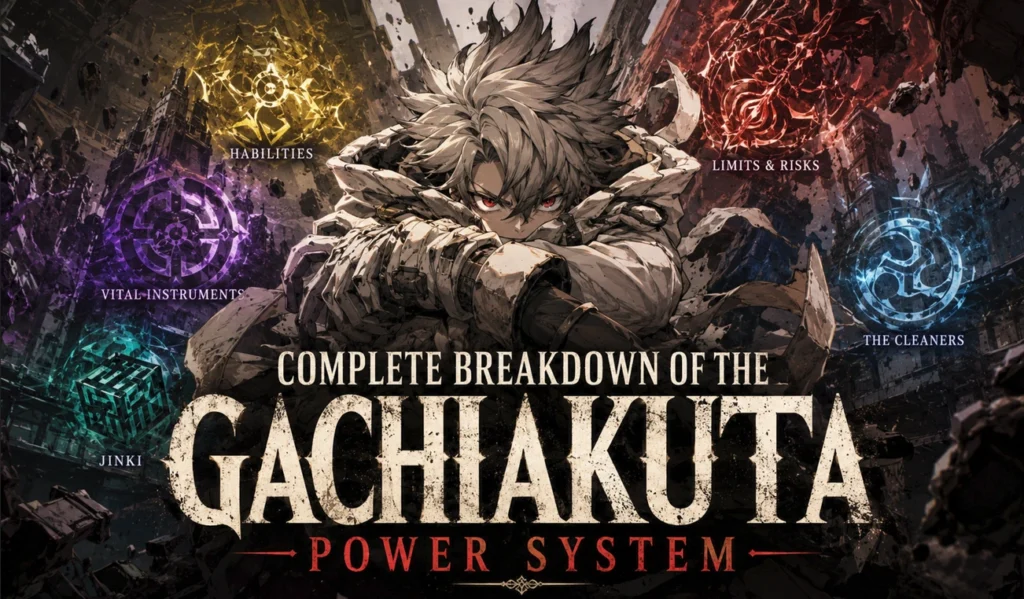
Table of Contents
- What Is the Gachiakuta Power System?
- Anima: The Fuel Behind Everything
- Vital Instruments (Jinki), Explained
- Attacker vs Defender Jinki
- How Power Actually Scales in Gachiakuta
- Why Rudo Breaks the Rules
- What Re-Watching Season 1 Reveals
- Where the Story Stands Right Now
- How It Stacks Up Against Other Shonen Systems
- FAQs: Gachiakuta
What Is the Gachiakuta Power System?
The Gachiakuta power system runs on Anima, a spiritual energy created by human thought and emotion. When someone forms a deep attachment to an object, that object can absorb enough Anima to gain a soul and become a Vital Instrument, or Jinki. The person who bonds with it is called a Giver, and Givers use their Jinki to fight Trash Beasts in the Pit.
That’s the one-sentence version. Everything else in this article is the how and why behind it.
Anima: The Fuel Behind Everything
In the world of Gachiakuta, thoughts and feelings aren’t abstract. They’re a measurable force. All thoughts and emotions manifest as a spiritual energy called Anima, and that energy is the life force that allows objects to be imbued with a soul. Beebom
This is what separates Gachiakuta from a generic “chosen one gets a magic sword” setup. The Pit itself is built from things the Sphere threw away, and the people living there were thrown away too. The pit is made entirely of discarded objects, and the people who live and fight there are also people the Sphere discarded, which is not accidental. The power system is the theme. That’s the information gain most SERP explainers miss: they describe Jinki as “cool trash weapons” without connecting it back to the story’s core metaphor about waste, memory, and worth. Wikipedia
If you want to see how another series builds its entire cosmology around a single energy source, our complete breakdown of the Jujutsu Kaisen power system does something similar with cursed energy, though the emotional mechanics work very differently.
Vital Instruments (Jinki), Explained
A Vital Instrument, or Jinki, is an object powered by Anima, and the people who use them are called Givers. Per the Gachiakuta Wiki, Givers have the ability to draw out the power within their Vital Instruments to fight Trash Beasts, and ordinary weapons simply don’t work on them. FandomGachiakuta
Rudo’s gloves. Enjin’s umbrella. Riyo’s scissors. None of these look like conventional shonen weapons, and that’s the point. According to the official Gachiakuta Wiki, a Giver may hold back their Vital Instrument’s power to avoid recoil, as seen with Semiu Grier’s Eyes, which would cause her to go blind if pushed to full power for too long. That’s a real cost, not a plot convenience. Fandom
The bond between Giver and Jinki has to be earned. You can’t just pick up a random object off the ground and expect it to activate.
Attacker vs Defender Jinki
The Gachiakuta power system splits every Vital Instrument into two combat roles:
- Attacker Jinki are built for offense and unlock aggressive abilities when pushed
- Defender Jinki exist purely to protect and can’t be used to attack
- Which category a Jinki falls into depends on what the Giver wants from it
- A Defender Jinki still supports the team in non-combat ways
- Jinki quality improves the longer a Giver treats it with care
- Refinement deepens the bond, which in turn increases output
- Each Giver is normally limited to one Vital Instrument
- Trash Beasts are effectively immune to non-Jinki weapons
Per Beebom’s breakdown of the system, if a Giver wants to draw out the full potential of a Jinki, it’s bestowed with powerful offensive abilities and becomes an Attacker’s Vital Instrument, while a Giver who wants to protect their belonging gets a Defender Jinki that can’t be used offensively. CBR
How Power Actually Scales in Gachiakuta
This is where the system gets genuinely unusual for the genre. Power doesn’t scale with training arcs or bloodlines. It scales with meaning.
| Scaling Factor | What It Does |
|---|---|
| Emotional intensity | Deeper attachment to the object produces more Anima |
| Consistency of care | Regularly maintaining the Jinki refines its quality over time |
| Psychological state | Grief, rage, or identity crisis can spike output mid-fight |
| Recoil tolerance | Stronger activation often comes with a physical cost |
| Giver exclusivity | Most Jinki are non-transferable and useless in another Giver’s hands |
A random object activated by someone with no real connection to it does almost nothing. A grieving, furious, or desperate Giver can pull something enormous out of an object that looks like junk. That’s a fundamentally different scaling logic than power systems built on raw technique, which is worth keeping in mind if you’re used to something like the reverse cursed technique in Jujutsu Kaisen or the layered Haki system in One Piece.
Why Rudo Breaks the Rules
Every Giver gets one Vital Instrument. Rudo doesn’t. According to the series’ established rules, each Giver can normally only have one Vital Instrument, but Rudo is an exception who is not limited to one cherished item and can create multiple of them, giving him an extreme advantage. Beebom
Manga readers will fight us on this, but Rudo’s exception isn’t just a power fantasy. It’s tied directly to how many objects, and how much resentment, he’s been forced to carry.
What Re-Watching Season 1 Reveals
Re-watching this arc, the detail most people skip is how often Vital Instruments fail before they succeed. Season 1 doesn’t frame Jinki activation as a light switch. It frames it as something closer to grief work, where the Giver has to actually confront what the object represents before it responds. That’s a slower, quieter kind of power-up than most Discover readers are used to from shonen, and it’s a big part of why Gachiakuta reads as more mature than its Weekly Shonen Magazine peers.
Where the Story Stands Right Now
As of this week, the fandom is split on how far Season 2 will push the Watchman Series Jinki, a tier of Vital Instruments still barely explored on screen. The most important Vital Instruments in Gachiakuta are the Watchman Series, and only a handful of these powerful weapons have been revealed thus far. Fandom
On the manga side, Gachiakuta has returned to a weekly release schedule after a brief hiatus, with new chapters coming out most Tuesdays on the KManga app. No confirmed date for Season 2 exists yet, but the second cour’s momentum and the show’s Anime of the Year nomination make it one of the safest bets for a 2027 return. sportskeeda
But here’s the real question: does Rudo’s multi-instrument ability make him overpowered, or does it just make him the most burdened character in the cast?
How Gachiakuta Stacks Up Against Other Shonen Systems
If you’re coming from a series with a rigid power hierarchy, Gachiakuta will feel looser on purpose. It has more in common tonally with an emotion-driven system than a technique-tree one. For context on how differently other franchises structure their power, check out our breakdowns of the Black Clover magic system, the Kagurabachi power system, and our Haki vs Cursed Energy comparison for a sense of how varied modern shonen scaling has become.
If you’re building a tier list mentally already, our ranking of every Jujutsu Kaisen character by power and our Demon Slayer Hashira ranking are good reference points for how we approach scaling elsewhere on the site.
FAQs: Gachiakuta
- What is Anima in Gachiakuta?
Anima is the spiritual energy created by human thoughts and emotions. It’s the force that lets discarded objects gain a soul and become Vital Instruments, and it powers every ability Givers use against Trash Beasts. - What is a Vital Instrument (Jinki) in Gachiakuta?
A Vital Instrument is an object a Giver has bonded with deeply enough that it gains a soul from Anima. It becomes their primary weapon, and it’s the only kind of weapon that actually works on Trash Beasts. - Why can Rudo use multiple Vital Instruments?
Most Givers are limited to a single Jinki, but Rudo is a rare exception who can create and control more than one, which the series treats as both an advantage and a burden tied to his backstory. - Are Vital Instruments transferable between characters?
No. A Jinki is bonded to the specific emotional history of its Giver, and the connection generally can’t be handed off to someone else. - Is Gachiakuta manga ahead of the anime?
Yes. The manga is currently past chapter 170 and releases most Tuesdays, well beyond where Season 1 of the anime left off. sportskeeda
Verdict
Gachiakuta’s power system works because it never lets you forget what the objects used to be. Anima ties strength directly to memory and grief instead of raw technique, and Rudo’s exception to the one-Jinki rule only makes that cost more visible. It’s one of the more emotionally honest power systems shonen has produced in years.
Where does Gachiakuta’s power system rank against your favorite shonen mechanics? Drop your tier list in the comments.