Here’s the question nobody in the fandom wants to sit with: what if the Rimuru you know already died once, in a future that technically hasn’t happened yet? The Rimuru Deaths woven through the light novel aren’t a single “bad ending” fans can shrug off. They’re a recurring failure state the timeline keeps generating until something finally breaks the loop. Here at Shonen Vortex, we’ve been tracking the Chronoa/Chloe time-travel thread since Volume 11 dropped the first hints, and this breakdown pulls together what Volume 12 actually confirms versus what fans have been guessing at for years. As of late 2026, this is still one of the most under-explained threads in the entire series, and most recap channels skip straight past it. (Detailed Breakdown of Chronoa’s powers)
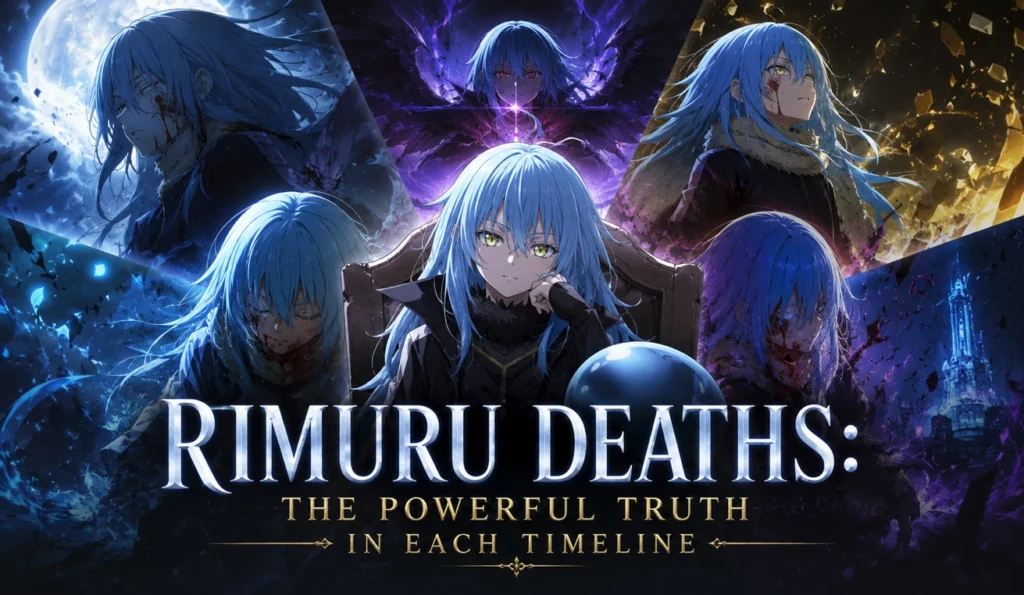
Table of Contents
- What Are the Rimuru Deaths in the Slime Timeline?
- The Original Future Timeline Nobody Talks About
- What Happens After Rimuru Dies
- Chloe’s Time Traveler Ability, Explained
- The Repeated Rimuru Deaths Across Multiple Loops
- Volume 12’s Bombshell: Rimuru Returns, Stronger Than Ever
- How the Current Timeline Escapes the Cycle
- The Biggest Unresolved Mystery
- FAQs
What Are the Rimuru Deaths in the Slime Timeline?
The Rimuru Deaths refer to a doomed future timeline, confirmed in Volume 12, where the Eastern Empire kills Rimuru and Tempest collapses without him. That failure kicks off a chain reaction: Veldora goes berserk, war breaks out between East and West, and Hinata eventually dies too. Her death is what actually triggers Chloe’s Time Traveler ability, sending her roughly 2,000 years into the past.
Quick facts before we go deeper:
- Rimuru never becomes a True Demon Lord in this doomed future.
- The Eastern Empire’s invasion is what ends him.
- Tempest collapses almost immediately after his death.
- Hinata’s death, not Rimuru’s, is the actual trigger for Chloe’s jump.
- Chloe lands roughly 2,000 years before the current story.
- This sequence of events has happened more than once.
- Volume 12 reveals Rimuru eventually comes back in one of these futures.
(Read our breakdown of the Eastern Empire Generals: Who Is the Greatest Threat?)
The Original Future Timeline Nobody Talks About
Re-watching this arc against the light novel, the detail most people skip is how differently Rimuru approaches the Empire in this failed future. In the current timeline, Rimuru negotiates, stalls, and eventually turns Clayman’s schemes and the Culling Game rules-style political traps into leverage against his enemies. In the doomed original future, he doesn’t get that runway. The Empire moves faster, harder, and Rimuru is caught before he can consolidate the power that later makes him untouchable.
That’s the core divergence. Rimuru never crosses the threshold into becoming a True Demon Lord. Without that awakening, Tempest is a nation built entirely on one monster’s presence, not his systems. When the Empire kills him, there’s no fallback. No Demon Lord, no army of subordinates strong enough to hold the line the way the current-timeline versions of Benimaru or Diablo eventually can. Tempest doesn’t weaken. It collapses outright.
Fans debating strongest characters ranked lists in other franchises tend to forget that raw power means nothing without the infrastructure to use it. That’s the whole thesis of this timeline. Rimuru’s individual strength was never the problem. His lack of a Demon Lord’s authority was.
(Read our breakdown of the The Strongest Primordial Demons Right Now in Tensura)
What Happens After Rimuru Dies
This is where the Rimuru Deaths stop being one bad event and start being a full-blown catastrophe. Veldora, bound to Rimuru, is released the moment his host dies, and he does not come back calm. His rampage alone destabilizes the region further, on top of a nation already leaderless.
From there, the war between East and West escalates in a way it never gets the chance to in the current timeline. This is the part fans consistently get wrong. The common shorthand is “Rimuru dies, so Chloe resets everything.” That’s not what happens. Rimuru’s death is the first domino. Hinata’s death is the actual trigger.
Hinata, one of the strongest holy knights in the setting, ends up dying in the fallout of this broader war. It’s her death specifically that activates Chloe’s latent Time Traveler ability, not Rimuru’s. That distinction matters because it re-frames the entire arc. This isn’t a “save the protagonist” loop. It’s Hinata’s death that the narrative treats as the real point of no return.
(Read our breakdown of the Ramiri’s Labyrinth which is the Empire’s ultimate nightmare?)
Chloe’s Time Traveler Ability, Explained
Chloe’s ability doesn’t activate on command. It’s triggered by extreme emotional and circumstantial pressure, specifically the loss of Hinata, and it fires her backward roughly 2,000 years before the present-day story. The mechanics of exactly how far and why 2,000 years specifically remain one of the LN’s more deliberately vague points, so treat any “exact year” claims you see online with caution.
What the novels do confirm is that Hinata becomes intertwined with Chloe across this jump, in a way that eventually seeds the existence of Chronoa, the masked Hero fans meet much earlier in the story chronologically. Chronoa isn’t a separate character bolted onto the plot. She’s a product of this exact failure state, a Hero created by the consequences of the Rimuru Deaths timeline.
If you’re newer to this thread and want the fuller power-system context before diving further, our complete breakdown of the Jujutsu Kaisen power system is a useful comparison for how “power granted through trauma or crisis” tends to work across shonen and isekai storytelling more broadly, even outside Slime itself.
The Repeated Rimuru Deaths Across Multiple Loops
Here’s the part that separates casual readers from people who’ve actually sat with Volume 12. This isn’t one failed timeline. It’s a recurring chain. The Rimuru Deaths happen more than once, in slightly different configurations, and Chloe carries fragments of memory forward from each iteration even when she can’t consciously access them.
We’re not going to invent a “Timeline 1, Timeline 2, Timeline 3” numbering system here, because the light novel deliberately doesn’t label the loops that cleanly. What it does show is small variables shifting between iterations. A different decision from Rimuru. A different survivor. A different length of time before the Empire strikes. Each variation nudges the outcome, but the fundamental shape, Rimuru dies, Tempest falls, Hinata dies, Chloe jumps, repeats with unsettling consistency.
Manga-only readers will fight us on this, but the novels make clear this loop structure is closer to the emotional core of Chronoa’s character than most adaptations have had room to show yet.
Volume 12’s Bombshell: Rimuru Returns, Stronger Than Ever
This is the single most important reveal for anyone tracking the Rimuru Deaths thread. In at least one of these failed futures, Rimuru doesn’t stay dead. He comes back, and Volume 12 is explicit that this resurrected version is considerably stronger than the Rimuru readers know from the current timeline.
According to Volume 12, this returned Rimuru crosses paths with Chronoa repeatedly, and the two clash multiple times. The framing isn’t a clean rivalry. It’s closer to two people caught on opposite sides of a timeline neither of them fully understands. Chronoa’s fragmented memories eventually surface a moment where Rimuru is holding her as she’s dying, which recontextualizes their entire dynamic once you connect it back to Hinata’s role in creating Chronoa in the first place.
| Doomed Future Timeline | Current Timeline |
|---|---|
| Rimuru dies to the Empire | Rimuru survives and consolidates power |
| Never becomes a True Demon Lord | Ascends to True Demon Lord status |
| Tempest collapses outright | Tempest grows into a major power |
| Hinata dies in the East-West war | Hinata survives and allies with Rimuru |
| Chloe jumps ~2,000 years back | No confirmed jump has occurred yet |
| Chronoa exists as a fractured Hero | Chronoa’s origin is still being uncovered |
Chronoa’s final leap in that failed future is what sends events back toward the timeline readers currently occupy, though the LN stops short of spelling out every mechanical detail of how that leap connects to the present.
How the Current Timeline Escapes the Cycle
So why does the timeline readers are currently following look different? The clearest answer the novels give is Chloe’s retained knowledge, even in fragments, subtly altering decisions around Rimuru and Hinata early enough to change outcomes. It’s a soft-reset, not a full memory wipe, and that distinction is why small character choices in the current arc carry more weight than they’d otherwise seem to.
Connect that back to Rimuru’s ascension to True Demon Lord status in the current timeline, something the doomed future never achieves, and the survival of Tempest stops looking like plot convenience. It looks like the direct result of the loop finally producing a version of events where the dominoes don’t all fall the same way.
The Biggest Unresolved Mystery
Even with Volume 12’s reveals, one core question stays open: who or what actually enables Rimuru’s resurrection in that doomed future? The novels show that it happens. They don’t fully explain the mechanism connecting his death, his return, Chronoa’s repeated battles with him, and her eventual leap back toward the past.
Fan theories fill in the gaps constantly, everything from Veldora’s influence to a Great Sage-adjacent system intervening, but none of that is confirmed text. If you see a video or thread stating this as settled fact, that’s fan interpretation dressed up as canon. The honest answer, as of the current volumes, is that this remains one of the series’ deliberately open threads.
FAQs
- Does Rimuru actually die in the light novel?
Yes, but only within a specific doomed future timeline confirmed in Volume 12, not in the current story readers and anime viewers are following. That future ends with the Empire killing him and Tempest collapsing shortly after. - Why does Hinata’s death matter more than Rimuru’s for Chloe’s time travel?
Hinata’s death is the direct trigger for Chloe’s Time Traveler ability activating. Rimuru’s death starts the collapse, but it’s Hinata’s loss specifically that sends Chloe roughly 2,000 years into the past. - Is Chronoa the same person as Chloe?
They’re connected through this exact timeline event, with Hinata’s fate intertwining into Chronoa’s existence, but the light novel treats their relationship as more complicated than a simple one-to-one identity, and doesn’t spell out every detail. - Has this loop happened more than once?Yes. Volume 12 implies a recurring chain of similar failed futures rather than a single isolated event, with Chloe carrying fragmented memories across iterations.
- Does the anime cover the Rimuru Deaths arc yet?
Not as of now. This material comes directly from LN Volumes 11 and 12 and hasn’t been adapted into the anime timeline at the time of writing.
Final Verdict
The Rimuru Deaths aren’t a throwaway “what if” for Slime’s light novel readers. They’re the emotional backbone behind Chronoa’s entire existence, and they quietly explain why the current timeline’s smallest decisions carry so much weight. Volume 12 confirms more than most recap content gives it credit for, even if the full mechanics of Rimuru’s return stay deliberately murky.
Where do you land on this? Do you think the LN eventually spells out exactly how Rimuru comes back, or is this staying ambiguous by design? Drop your read in the comments.