⚠️ Spoilers ahead through Demon Slayer manga Chapter 204 and the Infinity Castle arc
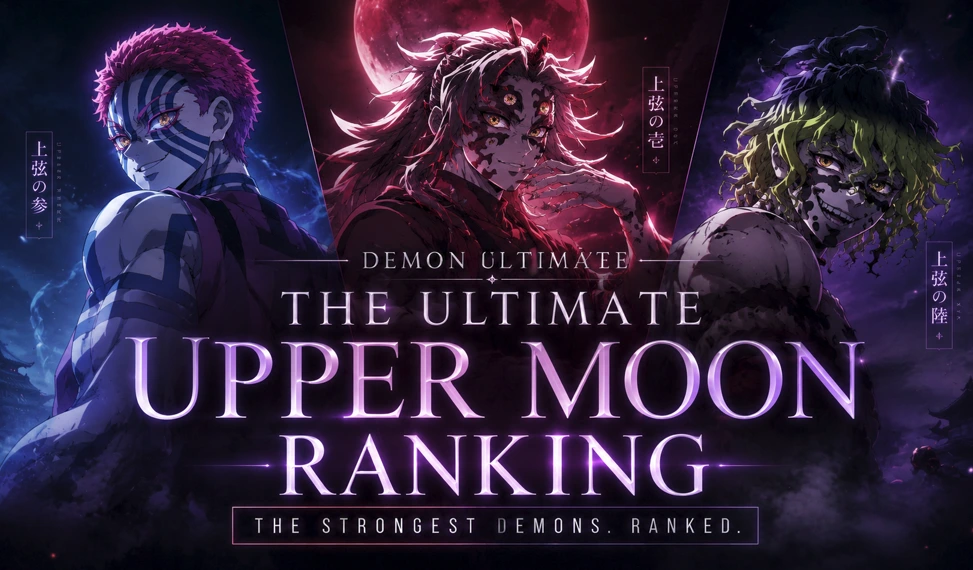
The Upper Moons are the most terrifying demons Muzan ever created. Six seats. Each one capable of killing a Hashira. But which one is truly the strongest? Here at Shonen Vortex, we’ve been tracking the Upper Moon power debate since the Mugen Train arc first rewired how fans think about demon threat levels, and we have receipts.
Most rankings you’ll find online stop at raw strength. We’re going deeper: Blood Demon Art complexity, battle IQ, near-defeat conditions, and actual kill count. The result is a ranking the fandom will fight over, and that’s exactly the point.
As of May 2026, with the Infinity Castle film arc now in full motion, this debate has never been louder.
Table of Contents
- What Makes an Upper Moon?
- Upper Moon Ranking Criteria
- Upper Moon Ranking: 6 Through 4
- The Top Three Upper Moons Ranked
- The Demon Slayer Power Gap Nobody Talks About
- FAQs: Upper Moon Questions Answered
- Final Verdict
What Are the Upper Moon Demons in Demon Slayer?
The Upper Moons are Muzan Kibutsuji’s six most powerful demons, ranked by blood concentration and raw killing ability. They sit above the Lower Moons entirely, and every single one has killed at least one Hashira across their centuries of existence. Unlike the Lower Moons, who were wiped out in a single meeting, the Upper Moons have held their seats for decades without changing.
According to the Demon Slayer manga (Chapter 97), Muzan himself states the Upper Moons have remained unchanged for 113 years. That’s not a ranking. That’s a dynasty.
What separates them:
- Each Upper Moon has absorbed more of Muzan’s blood than any Lower Moon
- Their Blood Demon Arts are uniquely evolved over centuries of combat
- They retain human memories, which sharpens tactical thinking
- Several have secondary or tertiary abilities that trigger mid-battle
- All six have survived encounters that would have ended any other demon
How We Ranked the Upper Moons
Before the list, here’s the scoring framework we used. Most power scalers make the mistake of only counting who hits harder. That’s incomplete. Gyutaro losing to two Hashira working in tandem tells a different story than Akaza nearly ending Rengoku alone.
Our criteria:
- Raw physical power and regeneration speed
- Blood Demon Art ceiling and versatility
- Battle IQ and adaptability
- Performance against Hashira-level opponents
- Muzan’s own assessment of the demon
Now. The ranking.
Upper Moon Ranking: Positions 6 Through 4
Upper Moon Six: Gyutaro and Daki
Gyutaro and Daki function as a single Upper Moon slot, which is already unusual. Daki handles surface-level combat and crowd control with her sash manipulation. Gyutaro is the actual threat, wielding Blood Demon Art: Rotating Circular Slashes: Flying Blood Sickles, which carry a lethal poison with no known antidote.
He came within inches of killing both Tanjiro and Inosuke simultaneously (Episode 10, Entertainment District Arc). Only Tengen Uzui’s sacrifice play and the simultaneous decapitation mechanic saved the Demon Slayers.
Still, two Hashira-level combatants plus two Demon Slayers were required to defeat one Upper Moon slot. That’s not a weak showing. Gyutaro is sixth because his Blood Demon Art, while deadly, lacks the reality-warping ceiling of the demons above him.
Upper Moon Five: Gyokko
Gyokko is genuinely underrated in most rankings. His Blood Demon Art allows him to generate fish-demons from pots, transmute humans into grotesque flesh structures, and create a water prison that suffocates opponents while he remains immune inside it.
In Chapter 127 of the manga, Gyokko activates his true form and demonstrates near-instant movement, total skin imperviousness, and poison scales. Muichiro Tokito, a Hashira, needed to unlock his Demon Slayer Mark just to compete. That’s the benchmark.
Gyokko ranks fifth because his true form has a meaningful weakness: it requires him to abandon his pot portals, stripping his tactical advantage. Still dangerous. Still mid-tier lethal.
Upper Moon Four: Hantengu
Hantengu might be the most frustrating Upper Moon to fight. His Blood Demon Art splits him into emotion-based clones: Sekido (wrath), Karaku (pleasure), Aizetsu (sadness), and Urogi (joy). Each clone is Hashira-tier by itself.
Destroy all four and he creates Zohakuten, a composite wood-dragon demon capable of sonic attacks that rip apart everything in range. Then, hiding inside Zohakuten, is the true body: a tiny, near-unkillable core that must be decapitated separately.
Three Demon Slayers including Tanjiro, Genya, and Nezuko were required to handle him (Swordsmith Village Arc, manga Chapter 117 through 135). Ranking him fourth feels almost too low. His survivability and clone mechanics make him one of the most complex fights in the series.
For more on how Demon Slayer’s power system stacks up against other shonen series, check out our breakdown of how cursed energy compares to Demon Slayer’s haki-adjacent system.
The Top Three Upper Moons Ranked
This is where rankings actually matter. The gap between Upper Moon Four and Upper Moon Three is significant. The gap between Three, Two, and One is a different conversation entirely.
| Rank | Demon | Blood Demon Art | Key Feat | Threat Tier |
|---|---|---|---|---|
| #3 | Akaza | Destructive Death: Disorder | Killed Flame Hashira Rengoku | Apex |
| #2 | Doma | Cryokinetic absorption | Killed former Water Hashira Kanae | Absolute |
| #1 | Kokushibo | Moon Breathing + demon physiology | Defeated multiple Hashira simultaneously | Transcendent |
Upper Moon Three: Akaza
Akaza is the Upper Moon the anime introduced as the face of “these demons are not beatable.”
His Blood Demon Art, Destructive Death, amplifies his martial arts with shockwave-based strikes called “Technique Development.” He fights purely in melee range, which means he forces every opponent to meet him at his strongest. He killed Rengoku in their first encounter (Episode 19 of Season 2), a certified peak Hashira.
Re-watching that fight, the detail most people skip is that Rengoku pushed Akaza to the edge at Flame Breathing’s Ninth Form. Akaza was not toying with him in the final exchange. He was genuinely being challenged. That means Rengoku pushed an Upper Moon Three to somewhere near his ceiling.
Akaza’s weakness: he refuses to fight women. That’s a tactical blind spot that would matter against a female Hashira. Still, pure head-to-head power places him at three comfortably.
For a deeper look at how Akaza’s battle IQ compares to the strongest Jujutsu Kaisen characters, the comparison raises interesting questions about battle intelligence as a power metric.
Upper Moon Two: Doma
Doma is the most uniquely broken demon on this list. His Blood Demon Art manipulates ice and cold at a molecular level, absorbing human bodies and converting them into his own flesh to strengthen himself continuously.
He killed Kanae Kocho, the former Flower Hashira, which is documented in Chapter 165 of the manga. He then nearly killed Shinobu Kocho. The only reason he fell was because Shinobu had laced her own body with wisteria poison over years, essentially turning herself into a weapon capable of poisoning a demon from the inside.
That’s not a combat defeat. That’s a trap that required a Hashira to die to set it.
Doma’s ranking at two is occasionally challenged by fans who argue Akaza would beat him in direct combat. Manga readers will fight us on this, but Doma’s absorbing capability, combined with his utter indifference to pain or emotion, makes him the more dangerous demon in sustained combat.
Upper Moon One: Kokushibo
There is no debate here.
Kokushibo is Yoriichi Tsugikuni’s twin brother. He was a Demon Slayer before becoming a demon. He is the only demon besides Muzan himself who has developed a Breathing Style as a demon: Moon Breathing, with sixteen known forms, each capable of generating blade-like projectiles from his sword that extend and mutate mid-swing.
According to Chapter 174 of the manga, Kokushibo simultaneously engaged Gyomei (Stone Hashira), Sanemi (Wind Hashira), Muichiro (Mist Hashira), and Genya. He overwhelmed all of them. Muichiro was killed in the encounter. Genya was killed. Two peak Hashira with active Demon Slayer Marks could not put him down without Yoriichi’s sword literally rotting mid-fight.
Here at Shonen Vortex, we’ve seen countless top three debates since the Mugen Train arc dropped, but Kokushibo’s performance in that room is the single most dominant Hashira-kill sequence in the series. No other Upper Moon comes close to that body count in a single engagement.
For context on how dominant that truly is, take a look at how we ranked every Hashira by strength and skill. When the top four Hashira can’t stop one demon, the ranking writes itself.
The Demon Slayer Power Gap Nobody Talks About
Trending across the fandom this month, with the Infinity Castle arc in cinemas, is a question nobody is answering clearly: Is there actually a meaningful gap between Upper Moon Two and Upper Moon One?
Yes. The gap is Yoriichi-shaped.
Kokushibo has spent centuries trying to surpass his brother and failed. That obsession pushed him to evolve his demon physiology in ways Doma never pursued. Kokushibo has multiple eyes embedded across his body, each tracking movement independently (Chapter 173). His regeneration during the fight outpaced what Stone Hashira strikes could permanently damage.
Doma is terrifyingly powerful. But Kokushibo exists in a different tier. The gap between them might be the second largest in the entire series, right behind the gap between Muzan and everyone else.
This is also why the Infinity Castle film’s second act is going to hit differently for anyone who read the manga. The choreography of that room has to carry the weight of what those numbers mean.
Speaking of franchise power ceilings, if you want to see a similar power gap analysis done for another series, our breakdown of whether Gojo is truly the strongest sorcerer uses the same framework and the conclusions rhyme.
Also worth reading alongside this piece: our breakdown of Yhwach and the Almighty if you want to see how shonen final bosses compare when the numbers get this extreme.
FAQs: Upper Moon Questions Answered
- Who is the strongest Upper Moon in Demon Slayer?
Kokushibo is the strongest Upper Moon by a significant margin. He is the only demon to have mastered a Breathing Style as a demon, and he defeated four Hashira-tier combatants simultaneously in a single encounter in Chapter 174. No other Upper Moon comes close to that performance in direct combat. - Is Doma stronger than Akaza?
Yes, and Akaza himself later acknowledges this indirectly through his rage at dying before Doma. Doma’s Blood Demon Art gives him a higher ceiling in sustained combat due to his absorption ability, even though Akaza’s hand-to-hand combat instincts are sharper in short exchanges. - Why is Gyutaro ranked below Gyokko and Hantengu?
Gyutaro is devastating but required two simultaneous decapitations to defeat, a mechanic that exposed the Demon Slayers’ strategy more than his weakness. Gyokko’s true form and Hantengu’s clone-and-core structure both represent more complex threat profiles that can’t be countered with a single coordinated strike. - Did any Upper Moon ever defeat Muzan?
No Upper Moon has ever defeated or defied Muzan successfully. Kokushibo is the closest to Muzan in raw power among the six, but there is never a point in the manga where that gap is seriously tested. - How did Kokushibo become an Upper Moon?
Kokushibo, originally Michikatsu Tsugikuni, chose to become a demon rather than die of illness while his brother Yoriichi survived. His obsession with surpassing Yoriichi drove his evolution as a demon over centuries, culminating in him developing Moon Breathing as a demon-enhanced version of the Breathing Style he practiced as a human.
Final Verdict
The Upper Moon ranking that actually holds up: Kokushibo is in a tier by himself, Doma edges Akaza on sustained threat, and Hantengu is criminally underrated by casual fans. The bottom three are separated by mechanics more than raw power.
With the Infinity Castle arc now showing on screen, every single one of these fights is about to be stress-tested by cinema-quality animation. Some rankings will hold. Some will shift when you see the choreography in real time.
The Upper Moons were never just strong. They were built to make the Hashira feel like humans again.
Where does your Upper Moon ranking land? Drop your tier list in the comments and tell us who you think deserves to move up.