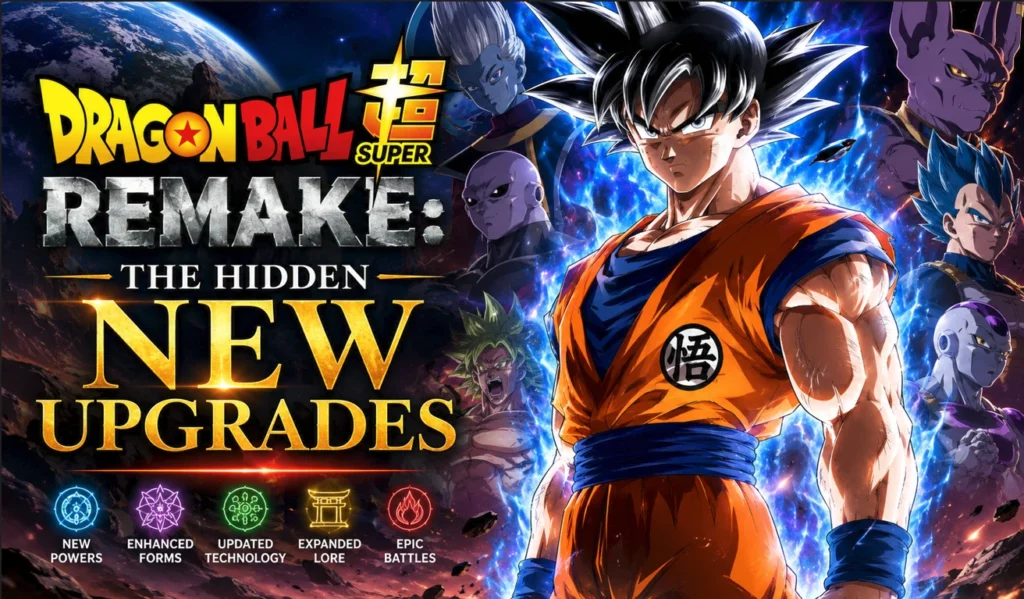
The Dragon Ball Super Remake is happening, and the fandom is louder than it’s been since Ultra Instinct first dropped. But most of the conversation is missing the actual story here. It’s not just a rerun with better colors. The upgrades Toei is bringing to this remake go deeper than anyone is talking about right now.
Here at Shonen Vortex, we’ve been tracking Dragon Ball’s production pipeline since the Daima announcement in 2023, and what we’re seeing lines up with a full rethinking of how Super was made, not just how it looked.
This breakdown covers what’s actually changing, what was broken in the original run, and why this remake could be the version of Super that finally does the manga justice.
Table of Contents
- What Is the Dragon Ball Super Remake?
- What Was Actually Broken in the Original Run
- The Hidden New Upgrades Toei Is Making
- Dragon Ball Super Remake vs. Dragon Ball Daima: What Toei Learned
- What Fans Are Getting Wrong About the Remake
- FAQs
- Final Verdict
What Is the Dragon Ball Super Remake Toei Just Confirmed?
The Dragon Ball Super remake is Toei Animation’s announced project to re-adapt the Dragon Ball Super manga with updated animation, revised pacing, and production quality closer to the theatrical film standard set by Dragon Ball Super: Broly (2018) and Dragon Ball Super: Super Hero (2022).
The original Dragon Ball Super anime aired from 2015 to 2018, often running ahead of Akira Toriyama’s manga. That caused filler arcs, off-model animation, and pacing issues that became memes. The remake is positioned as the corrected version, built on the source material from the ground up.
Key confirmed details so far:
- Re-adaptation of the Dragon Ball Super manga, not a remaster of the original anime
- New animation direction separate from the 2015 series
- Production influenced by lessons from Dragon Ball Daima (2024)
- No confirmed air date as of June 2026, but Toei has acknowledged the project publicly
- Toriyama’s original notes and drafts are being referenced, per statements made ahead of Daima’s release
What Was Actually Broken in the Original Run
Before we get to the upgrades, let’s be honest about what needed fixing. The original Super had real structural problems that went beyond a few bad frames.
The original Dragon Ball Super anime had these core issues:
- Battle of Gods and Resurrection F arcs were padded to match the films already in theaters
- The Universe 6 Tournament had inconsistent power scaling that contradicted established canon
- Future Trunks Arc introduced the Mafuba plot hole that the fandom still argues about
- Universe Survival Arc had some of the worst off-model frames in Toei’s modern history (Episodes 109-110 being the notable exception)
- Goku Black’s arc was rushed in the final act despite having the best setup in the entire series
- The manga and anime told genuinely different stories in the Zeno Expo and Tournament of Power
The Tournament of Power finale, for example, handled Android 17’s sacrifice completely differently in the manga. That’s not a small detail. That’s a character moment that changes how you read the whole arc. If you want to see how power systems stack up across series, our breakdown of Haki vs Cursed Energy shows exactly how different creative decisions shape fan perception of the same fight.
The Hidden New Upgrades Dragon Ball Super Remake Is Bringing
This is where it gets interesting. The obvious upgrade is animation quality. But that’s the surface. Here’s what’s actually changing.
Production pipeline shift. Dragon Ball Daima was Toei’s test run for a new production model. Smaller episode count, tighter scripting, higher per-episode budget. According to reporting from Anime News Network on Daima’s production, Toei restructured its Dragon Ball unit specifically to avoid the weekly grind that caused Super’s quality dips. The remake is expected to inherit that structure.
Manga-faithful scripting. The Dragon Ball Super manga, written by Toyotaro with Toriyama’s supervision, is tighter than the anime was. Vegeta’s Ultra Ego development, for example, is a manga-exclusive power-up that the anime never got to. The remake is built around adapting that version of the story. That means Vegeta finally gets his proper arc. That alone changes the whole show.
Revised fight choreography. The Broly film changed what Dragon Ball fights can look like. Super Hero pushed it further with CG integration. The remake is reportedly targeting film-level movement for key battles, not TV budget approximations. The Goku vs. Jiren fight in Episode 130 was peak TV Dragon Ball. Imagine that as the floor, not the ceiling.
Toriyama’s unreleased notes. This is the one that most outlets aren’t touching. Before Toriyama passed in March 2024, he left detailed notes and drafts for future Dragon Ball projects. Toei has confirmed those materials are being used in ongoing productions. Whether the remake directly uses them is unconfirmed, but the timing of this project post-Toriyama is not a coincidence.
If you’re tracking how anime series handle power escalation across seasons, our look at every JJK cursed technique ranked by power shows the kind of systematic breakdown the Dragon Ball remake needs to nail to satisfy modern anime fans.
Dragon Ball Super Remake vs. Dragon Ball Daima: What Toei Learned
Dragon Ball Daima premiered in October 2024 and ran 20 episodes. It was the first major Dragon Ball anime project post-Toriyama, and Toei treated it as a proof of concept.
What Daima proved:
- A shorter, focused Dragon Ball season can hold massive viewership
- The chibi art style was divisive but the pacing was universally praised
- Per Crunchyroll’s 2024 simulcast data, Daima consistently ranked in their global top 10 during its run
- The production team could deliver consistent animation quality when not locked into a 52-episode weekly grind
The Dragon Ball Super remake inherits all of that. Toei now knows a prestige Dragon Ball project works. They’ve tested the model. The remake is the full deployment.
The gap between Daima’s tight 20-episode run and the original Super’s bloated 131-episode schedule is where the real upgrade lives. Fewer episodes, better everything. If you want a comparison of how anime studios handle these kinds of production pivots, our breakdown of JJK manga vs anime covers the same tension between source fidelity and adaptation pacing.
What Fans Are Getting Wrong About the Dragon Ball Super Remake
Right now, the fandom is split on two bad takes.
Bad Take 1: It’s just a remaster. It’s not. A remaster cleans up existing footage. This is a full re-adaptation from the manga. Different scripts. Different pacing. Different story in some arcs. Calling it a remaster undersells it and misleads newer fans.
Bad Take 2: It’s disrespecting the original. The original Super had problems. Toei knows that. The remake is an acknowledgment that the 2015 run was compromised by its own production schedule. Treating the original as sacred ignores that Toriyama himself was not satisfied with how certain arcs were animated.
The manga readers will fight us on the Goku Black arc specifically, but the anime version of that finale was rushed in a way the manga simply wasn’t. Re-watching the final Zamasu episodes back to back with the manga chapters, the gap in storytelling quality is obvious.
Trending across Dragon Ball fan spaces this week: debate around whether the remake should include the Broly and Super Hero films as canon arcs or skip them entirely. That’s a real question the production team will have to answer.
For context on how iconic villain rankings shift when a series gets retold, check our breakdown of every JJK villain ranked to see how re-evaluation works in real time.
FAQs
What is the Dragon Ball Super remake?
It is a full re-adaptation of the Dragon Ball Super manga by Toei Animation, separate from the 2015 anime series. It uses updated animation and manga-faithful scripting to retell the Super story with higher production quality. No official release date has been confirmed as of June 2026.
Will the Dragon Ball Super remake fix the animation quality issues?
Yes. The remake is targeting a production model closer to the Dragon Ball Super films, informed by Toei’s work on Dragon Ball Daima. The weekly TV grind that caused off-model frames in the original will not apply to this project.
Is the Dragon Ball Super remake canon?
The remake adapts the manga, which is the source Toriyama supervised directly. In terms of fidelity to Toriyama’s vision, the remake will be more canon-aligned than the original anime was in several arcs, particularly Future Trunks and the Tournament of Power.
Will Vegeta get a better arc in the Dragon Ball Super remake?
Almost certainly yes. Vegeta’s Ultra Ego awakening and his distinct philosophical growth arc are manga-exclusive developments the 2015 anime never reached. The remake is built to tell that story.
When is the Dragon Ball Super remake release date?
No confirmed date as of June 2026. Toei has acknowledged the project but has not issued an official premiere window. Per Dragon Ball Super Season 2 release date reporting here, speculation continues but nothing is locked.
Final Verdict
The Dragon Ball Super remake is not a nostalgia play. It’s a correction. Toei has better tools, a tested production model from Daima, Toriyama’s reference materials, and a manga that is genuinely better structured than the anime it spawned.
The hidden upgrades are not just visual. They’re structural. Tighter pacing, manga-faithful arcs, and a production team that learned from the original’s biggest failures.
This has the potential to be the version of Super that newcomers watch first and veterans finally recommend without caveats.
Where does the Dragon Ball Super remake sit on your hype scale? And which arc are you most desperate to see done properly? Drop your answer in the comments.