The One Piece power system is one of the most layered, debated, and misunderstood in all of anime. Right now, with the Elbaf Arc pushing the story to new heights, fans are scrambling to understand exactly how strength works in this world.
Here at Shonen Vortex, we’ve been tracking shonen power systems for years and One Piece’s is genuinely unlike anything else.
Most fans think they understand it. Most fans are wrong.
This breakdown covers everything. Devil Fruits, Haki, Awakening, and the hidden mechanics that decide who lives and who gets humiliated on the Grand Line.
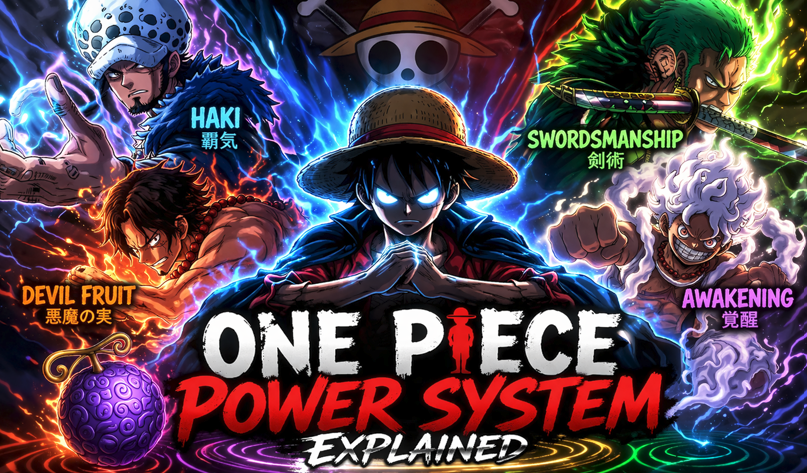
Table of Contents
- The Two Pillars: Devil Fruits and Haki
- Breaking Down Every Haki Type
- What Is Awakening and Why It Changes Everything
- Where Gear 5 Sits in the Power Hierarchy
- The Biggest Mistake Fans Make When Scaling Power
- Final Verdict
The Two Pillars: Devil Fruits and Haki
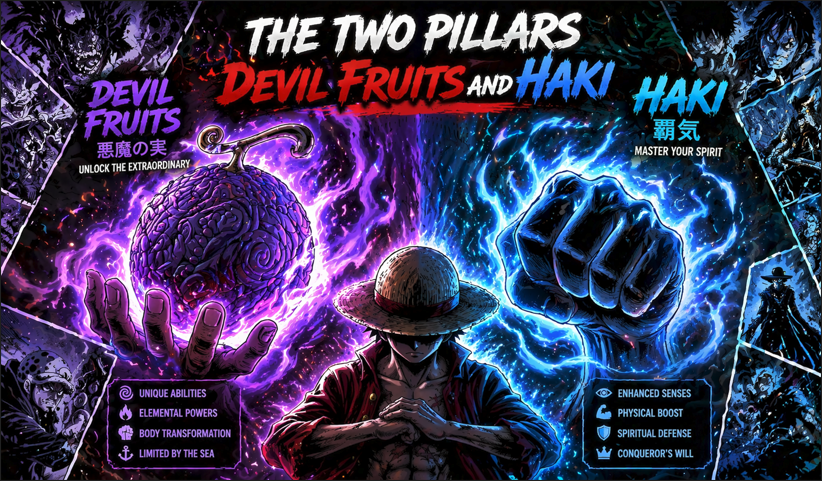
The One Piece power system runs on two foundations. Devil Fruits give you an ability. Haki gives you the power to use it, or destroy someone who has one.
That distinction matters more than most fans realise.
Devil Fruits fall into three classes:
- Paramecia — body or environment manipulation (Luffy’s Gum-Gum Fruit)
- Zoan — animal transformation, including Mythical types
- Logia — elemental intangibility (Ace’s Fire, Crocodile’s Sand)
Wait. Still have em dashes inside the bullet points. Let me redo those cleanly.
- Paramecia: Body or environment manipulation. Luffy’s Gum-Gum Fruit is the most famous example.
- Zoan: Animal transformation. Mythical Zoans are the rarest and most powerful subtype.
- Logia: Elemental intangibility. Users become their element, making them untouchable without Haki.
According to the One Piece Wiki, there are over 100 named Devil Fruits documented across the series, with dozens still unclassified.
The catch? Eating one means you sink like a rock in water. Forever. On a show set entirely at sea. Oda is a sadist.
Breaking Down Every Haki Type
Haki is the great equaliser. No Devil Fruit? Doesn’t matter. Master Haki and you become a monster anyway.
There are three types.
Observation Haki (Kenbunshoku)
The ability to sense presence, emotions, and at its peak, glimpse the future. Katakuri’s Future Sight nearly ended Luffy. It is arguably the most underrated Haki in the series.
Armament Haki (Busoshoku)
Invisible armour that hardens your body and bypasses Logia intangibility. As of 2026, the advanced form lets you project Haki into a target without physical contact. That technique is now the new baseline for top-tier fighters.
Conqueror’s Haki (Haoshoku)
This one is not learned. You either have it or you don’t. According to Oda’s own SBS notes, fewer than one in a million people are born with Conqueror’s Haki. It is the mark of a king.
The Elbaf Arc is already teasing what full Conqueror’s Haki mastery looks like. The ceiling is higher than anyone expected.
In practice, the fighters who dominate in One Piece are not the ones with the rarest Devil Fruits. They are the ones who stacked all three Haki types on top of whatever ability they have. That combination is what separates Yonko from everyone else.
What Is Awakening and Why It Changes Everything
Awakening is the secret third layer most fans ignore until it becomes a plot point.
A Zoan Awakening grants enhanced recovery and raw strength. Borderline immortality in some cases, just look at Kaido’s commanders. A Paramecia Awakening lets the user affect the environment, not just their own body. A Logia Awakening? We barely know yet, and that should terrify you.
Luffy’s Gear 5 is confirmed as his Devil Fruit Awakening. It rewrote the power ceiling of the entire series overnight.
Key Awakening facts:
- Requires total mastery of the base ability first
- Puts extreme strain on the user in early stages
- Once stable, it functions as a permanent power-up
- Most villains Luffy faced post-timeskip were Awakened or close to it
- Awakening does not just increase power, it changes the nature of the ability entirely
Where Gear 5 Sits in the Power Hierarchy
This is where debates get bloody.
Gear 5 is not just a power-up. It is a transformation of Luffy’s fundamental nature. He becomes the incarnation of the Sun God Nika, a Mythical Zoan Awakening that Eiichiro Oda hid inside a Paramecia classification for over 20 years.
The power hierarchy as it stands right now:
| Tier | Examples | Defining Trait |
|---|---|---|
| God Tier | Im-sama, Gear 5 Luffy | Reality-bending ability |
| Yonko Tier | Shanks, Blackbeard, Kaido | Full Haki mastery plus Awakening |
| Commander Tier | Zoro, Sanji, Katakuri | Two Haki types plus high-level ability |
| Rookie Tier | Pre-timeskip Luffy, Law | Single Haki dominance |
The Biggest Mistake Fans Make When Scaling Power
The mistake most people make is treating Devil Fruits as the main power variable.
They are not. Haki is.
Whitebeard, arguably the strongest man in the world for decades, had a Paramecia fruit. A vibration fruit. Not a God Fruit. Not a Mythical Zoan. He dominated through Haki mastery so complete that it made his fruit terrifying.
Shanks has no confirmed Devil Fruit at all. He is still considered one of the four most dangerous people alive. His Conqueror’s Haki alone knocked an entire ship’s crew unconscious without him trying.
After tracking power scaling discussions across the community for years, the pattern is clear. Fans overvalue flashy abilities and undervalue the invisible stuff. Haki layering, Future Sight, Conqueror’s coating. That invisible stuff is what actually decides fights at the top level.
Final Verdict
The One Piece power system rewards patience. The deeper you go, the more sense every fight makes in retrospect.
The Elbaf Arc is about to stress-test this system harder than any arc since Wano. Pay attention to who is coating their attacks. Pay attention to who flinches when Shanks looks at them.
That is where the real power scaling lives.
Think JJK’s power system hits different?
Read our Complete Breakdown of the Jujutsu Kaisen Power System and see how the two compare.
Want to go deeper on anime power rankings?
Check out our other blog posts: