Introduction
The Seven Days Clergy looks like a church. It is not a church. Here at Shonen Vortex, we’ve been tracking Lubelius since Hinata first drew her sword on Rimuru, and the pattern only gets uglier the closer you look. Most breakdowns stop at “they’re corrupt priests.” We’re going further: we’re tracing exactly how the Seven Days Clergy manufactured a war, buried the evidence, and got away clean until Diablo showed up. As of late 2026, with Tensura’s manga still peeling back Lubelius history, this is the version of the story most recap sites haven’t caught up to yet.
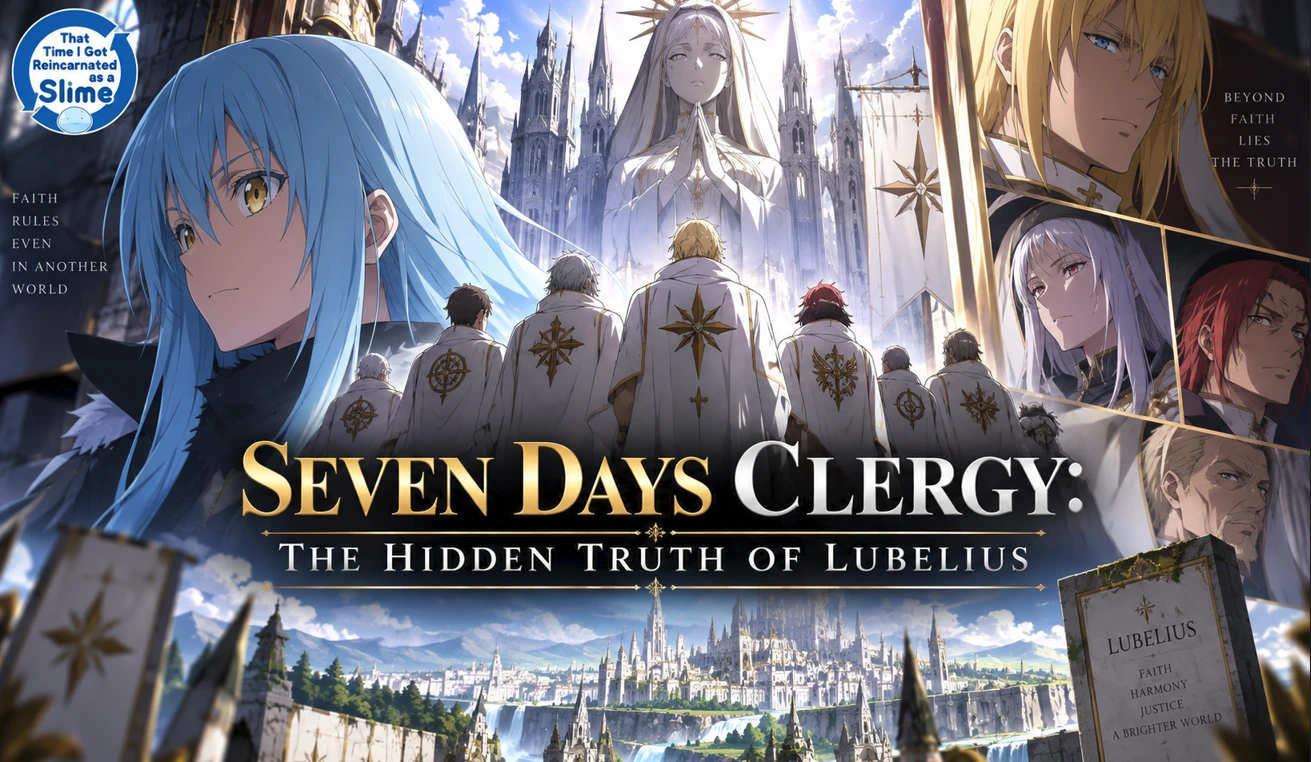
Table of Contents
- What Is the Seven Days Clergy?
- The Seven Days Clergy’s Real Power Structure
- Seven Days Clergy vs the Ten Great Saints
- How the Seven Days Clergy Set Up Hinata
- The Hidden Truth of Lubelius
- Where the Seven Days Clergy Fits in Tensura’s Bigger Conspiracy
- FAQs
What Is the Seven Days Clergy?
The Seven Days Clergy is the ruling religious body of Lubelius, the holy nation built around worship of Luminous Valentine. On paper they’re clerics. In practice they’re a council that manipulates the Crusaders, the Ten Great Saints, and even Hinata Sakaguchi herself, all while hiding behind Luminous’ name. That’s the short version. The long version involves a rigged sword, a dead cardinal, and a war they wanted.
The Seven Days Clergy’s Real Power Structure
Strip away the robes and the Seven Days Clergy is a chain of command built for deniability. Here’s how it actually breaks down:
- Seven members total, each secretly a Clerics of the Seven Luminaries operative
- They oversee the Crusaders and assign every major mission, including Hinata’s
- Led in practice by Granbell Rosso, who answers to almost no one
- They gave Hinata the Dragon Buster, a blade rigged to fail against Rimuru
- They sabotaged talented knights before Hinata’s rise, to protect their own standing
- They sent Cardinal Adalmann and Paladin Albert to die against a Dragon Zombie
- Two of them showed up specifically to stop healing magic from reaching Hinata
That last point is the one people gloss over. It’s not incompetence. It’s attempted murder of their own asset.
Seven Days Clergy vs the Ten Great Saints
| Faction | Role in Lubelius | Loyalty | Known For |
|---|---|---|---|
| Seven Days Clergy | Governs the church and the Crusaders | To themselves, not to Luminous | Rigging the Rimuru-Hinata conflict |
| Ten Great Saints | Elite combat unit under Hinata | To Hinata, mostly | Front-line muscle, kept in the dark |
| Clerics of the Seven Luminaries | The real identity behind the Clergy | To Granbell | Sabotage, false trials, cover-ups |
The Ten Great Saints thought they were following orders from a holy institution. They were following orders from seven people protecting their own immortality contract with Luminous.
How the Seven Days Clergy Set Up Hinata
Re-watching this arc, the detail most people skip is the timing. As shown in Chapter 261 of the light novel, the Seven Days Clergy hands Hinata the Dragon Buster right before she confronts Rimuru, knowing full well what the blade does to holy magic afterward. In Episode 7 of Season 3, titled “Holy and Demonic Clash,” the anime makes the manipulation explicit: the Clergy pushes the Great Paladins toward Rimuru’s nation through deliberate misinformation, not miscommunication. That’s a receipt, not a fan theory.
Then it gets worse. Once Hinata is gravely wounded by her own weapon, two members of the Clergy arrive not to save her, but to physically restrain the Saints trying to heal her. That’s the moment the Seven Days Clergy stops being “shady church politics” and becomes attempted assassination of the person who trusted them most.
Manga readers will fight us on this, but the anime actually undersells how cold that scene is.
The Hidden Truth of Lubelius
Here’s the information gain most recap articles miss: Lubelius isn’t corrupt because a few bad priests got greedy. It’s corrupt by design. The entire “Trials of Seven Luminaries” system that selected Hinata as Crusader captain wasn’t a meritocracy. It was a filter built by the Clergy to keep dangerously strong humans, like the cardinal and paladin they sent to die, from ever outgrowing them. Granbell didn’t fear an enemy outside Lubelius. He feared his own people.
Trending across the Tensura fandom right now is the debate over how much of this connects to the Chronoa reveal and why Granbell wanted her awakened in the first place. If the Seven Days Clergy has been managing Lubelius as a long game for centuries, the Hinata incident wasn’t an isolated scheme. It was one move in a much older plan, one that also touches the Holy Ark that Luminous sealed.
But here’s the real question: was Hinata’s near-death a rogue decision by two panicking clerics, or was it always the contingency plan? If it’s the latter, every “trial” Lubelius ever ran needs a second look.
Where the Seven Days Clergy Fits in Tensura’s Bigger Conspiracy
The Seven Days Clergy doesn’t operate in a vacuum. Their fingerprints show up whenever Lubelius needs a fall guy, and that pattern lines up with how the Eastern Empire’s generals also treat their strongest assets as disposable tools. It’s worth comparing the two nations directly if you want the full picture of how Tensura’s human factions actually run, which is exactly what our breakdown of the Eastern Empire’s army covers.
For power scaling purposes, none of the individual Clergy members rank near the strongest Primordial Demons or even Veldora at full strength. Their weapon was never combat power. It was information control, and that’s arguably scarier in a world where a wrong rumor can start a war between a Demon Lord and a Holy Nation.
Pick one: was Diablo exposing the Seven Days Clergy the moment Lubelius actually became honest with itself, or just the moment they got caught?
FAQs
- Is the Seven Days Clergy the same as the Ten Great Saints?
No. The Ten Great Saints are combat specialists led by Hinata. The Seven Days Clergy governs above them, controlling assignments and doctrine while staying hidden behind Luminous’ authority. - Did Luminous know what the Seven Days Clergy was doing?
The light novel implies she was largely unaware of specific plots like the Dragon Buster setup, though she had long tolerated the Clergy’s internal politics as a necessary evil. - Why did the Seven Days Clergy want Hinata to fight Rimuru?
They wanted a decisive event that would either eliminate Rimuru or cement Hinata’s loyalty through conflict, giving the Clergy tighter control over Lubelius either way. - Is Granbell Rosso part of the Seven Days Clergy?
Granbell effectively leads the Clerics of the Seven Luminaries, the true identity operating behind the Seven Days Clergy’s public face.
Final Take
The Seven Days Clergy isn’t a background faction. It’s the reason Rimuru and Hinata almost destroyed each other over a misunderstanding that was never accidental. Once Diablo pulled the thread, the whole holy nation’s foundation cracked. Where does the Seven Days Clergy rank on your list of Tensura’s worst manipulators? Drop your tier list in the comments.