Tensura Time Travel Is More Than a Gimmick, and Here’s Proof
Rimuru dies. A lot. That’s not a joke, it’s the premise. Our Rimuru Deaths article already broke down every timeline where he falls, and readers would not stop asking the same follow up question in the comments: how does the loop actually work?
That’s what this one answers. Tensura time travel isn’t a throwaway plot device, it’s the mechanism holding the entire Chronoa saga together, and most explainers stop at “Chloe resets things” without ever explaining the how or the why.
Here at Shonen Vortex, we’ve been tracking the Chronoa arc since the Eastern Empire invasion first dropped, and we’ve mapped every reset point Rimuru and Hinata have lived through. As of November 2026, the fandom is still split on whether this counts as a true time loop or a multiverse of parallel timelines. We’re settling that debate here.
Jump to:
Chloe’s Power · Rimuru’s Deaths · Hinata’s Deaths · Chronoa Explained · The 2,000 Year Jump · Why the Loop Repeats · Loop vs Timelines · FAQs
What Is Tensura Time Travel, Exactly?
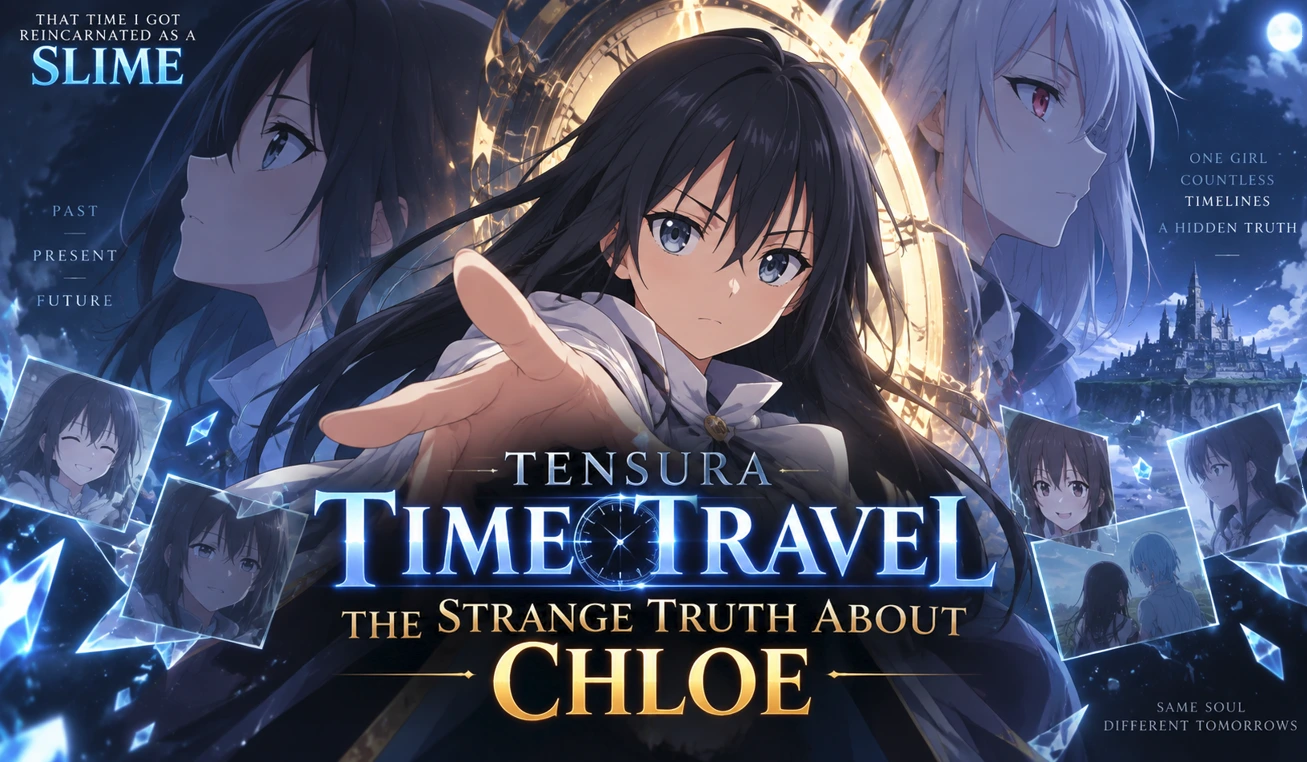
Tensura time travel refers to the ability Chloe Ophelia possesses to reset events across a fixed window of time, using Chronoa, one of her acquired Ultimate Skills. Every reset erases the previous outcome from the perspective of most characters, but Chloe retains fragments of memory across every version, which is the entire reason she keeps intervening.
That single sentence answers most search queries cold, but the mechanics behind it are where this gets genuinely strange.
Chloe: The Girl Who Keeps Rewinding the Story
Chloe isn’t a side character who happens to have time powers. She’s the person the entire timeline structure orbits around, and most casual readers underestimate her because she spends so much of the story as a background classmate.
Re-watching this arc, the detail most people skip is that Chloe’s resets were never framed as heroic in the source material. They’re framed as desperate. Every version of the timeline she erases is a version where people she loves die, and Chronoa lets her try again. That’s not a superpower flex, that’s grief on a loop.
Quick facts on Chloe’s role:
- She originates from a future timeline, not the “present” the story opens in
- Her Chronoa skill can rewind events across a bounded window, not the entire multiverse
- She retains partial memories other characters lose after a reset
- Her resets are triggered by catastrophic loss, most often Rimuru’s death
- She’s connected to Yuuki through a shared origin most fans miss on first read
- Her power has hard limits, it can’t undo everything indefinitely
Rimuru’s Deaths Are the Trigger, Not the Story
We already catalogued every Rimuru death across the timeline in detail, so we won’t repeat the full list here. What matters for this piece is the pattern: Rimuru’s death is consistently the event that forces Chloe’s hand.
That’s the part most breakdowns miss. The loop isn’t random. It’s reactive. Chloe doesn’t rewind because she’s bored of a bad outcome, she rewinds because the Eastern Empire’s invasion, or a specific confrontation, ends with Rimuru gone, and the timeline she’s protecting can’t survive that outcome.
Hinata’s Deaths Complicate Everything
If Rimuru is the trigger, Hinata Sakaguchi is the complication. Her fate is tangled directly into Chloe’s resets, and we broke down her Chronoa link in a dedicated piece because it deserves its own space.
Here’s the short version. Hinata dies or nearly dies in more than one version of events tied to the Eastern Empire’s Generals, and her survival across resets is not guaranteed the same way Rimuru’s is. That asymmetry is the strongest evidence that this isn’t a clean save-and-reload system. Different characters survive different resets for different reasons, which points toward something closer to branching timelines than a single corrected loop.
What Is Chronoa, and Why Does It Break the Rules?
Chronoa is Chloe’s Ultimate Skill, and it’s built specifically around temporal manipulation rather than combat output like most Ultimate Skills in this series. According to the light novel’s framing of the skill, Chronoa allows Chloe to return to a fixed point and carry forward memory fragments that shouldn’t logically persist.
We covered the origin of this skill and why Luminous chose to seal it in our Holy Ark breakdown, and that sealing decision is the single biggest clue about how dangerous this power actually is. Luminous doesn’t seal things out of caution. She seals things that terrify her.
Bold claim worth sitting with: Chronoa isn’t a time travel skill in the way anime fans usually mean it. It’s closer to a save-state mechanic layered onto a living person, and that person is running out of saves.
The 2,000 Year Jump: What Actually Happens
The 2,000 year gap is where the Chronoa arc stops being a simple rewind story and becomes a full timeline puzzle. Chloe’s origin point sits roughly two millennia ahead of the “current” Tensura timeline readers have been following since volume one.
That gap matters because it means Chloe isn’t traveling backward from her own present into ours. She’s collapsing distance between two eras that were never meant to touch, using Chronoa as the bridge. Everything Granbell Rosso wants, everything the Eastern Empire is chasing, ties back to controlling or replicating that jump. We go deeper on Granbell’s motive in our breakdown of why he wanted Chronoa awakened.
Why Does the Loop Keep Occurring?
The loop repeats because Chloe hasn’t found a version of events where the people she’s trying to protect all survive without triggering a worse outcome somewhere else. Every reset trades one disaster for a different one, and that’s the tragic engine driving the whole arc.
Think of it less like a video game retry and more like a person redoing the same argument in their head, trying different words each time, never landing on the version where nobody gets hurt.
But here’s the real question: is Chloe the hero of this arc, or is she the reason the timeline keeps breaking in the first place?
Loop vs Timelines: Settling the Debate
This is where the fandom actually fractures, and it’s worth laying out both sides before picking one.
| Theory | Evidence For | Evidence Against |
|---|---|---|
| Single time loop | Chloe retains memory across resets, implying one continuous line | Different characters survive different resets, which a clean loop shouldn’t allow |
| Parallel timelines | Explains why Hinata’s fate shifts independently of Rimuru’s | Doesn’t explain why Chloe’s memory persists across supposedly separate branches |
| Hybrid model | Matches both memory persistence and inconsistent survival outcomes | Not explicitly confirmed in the text, still theory-crafting |
After tracking this debate across the fandom, here’s what holds up: the hybrid model. Chloe’s Chronoa doesn’t create infinite parallel worlds, and it doesn’t run a single clean loop either. It behaves like a branching structure where only one branch stays “live” at a time, but residue from the dead branches leaks through as her memory. That’s why the current timeline feels different in small, specific ways rather than being a total reset.
Manga and light novel readers will fight us on this, but the current timeline is not a full restart. It’s a patched version, and the patches are visible if you know where to look.
How the Current Timeline Differs
The timeline readers are following right now shows small deviations that only make sense if resets have already happened off-page. Relationships form earlier than they logically should. Certain characters show foreknowledge they shouldn’t have. None of this is explained outright, it’s seeded, the same way the Chronoa reveal itself was seeded chapters before it was confirmed.
FAQs: Tensura Time Travel Explained
Is Chloe from the future or a different timeline?
Chloe originates from roughly 2,000 years ahead of the story’s present, connected to that era through Chronoa. Whether that counts as “the future” or a separate branch is exactly what the fandom debates, and the evidence leans toward a branching structure rather than a single future.
Does Rimuru remember dying after a reset?
No, Rimuru does not retain memories across resets the way Chloe does. His deaths are the trigger for the loop, but he experiences each version as the only version, which is part of what makes Chloe’s burden so isolating.
Why did Luminous seal Chronoa?
Luminous sealed Chronoa because of how catastrophically it can reshape events, treating it as too dangerous to leave active. We cover her full reasoning in the Holy Ark piece linked above.
Is this a true time loop like other anime?
Not exactly. It behaves more like branching timelines with memory bleed-through, closer to a hybrid model than a classic Groundhog Day style loop.
The Verdict on Tensura Time Travel
Chloe’s power isn’t a gimmick bolted onto the story, it’s the emotional core of the Chronoa arc. Rimuru’s deaths trigger it, Hinata’s survival complicates it, and the 2,000 year gap is the reason it exists at all.
This isn’t a clean loop. It’s closer to a patchwork of near-misses, held together by one girl who remembers every version where she failed.
Where do you land? Time loop or parallel timelines? Drop your take in the comments.