Introduction
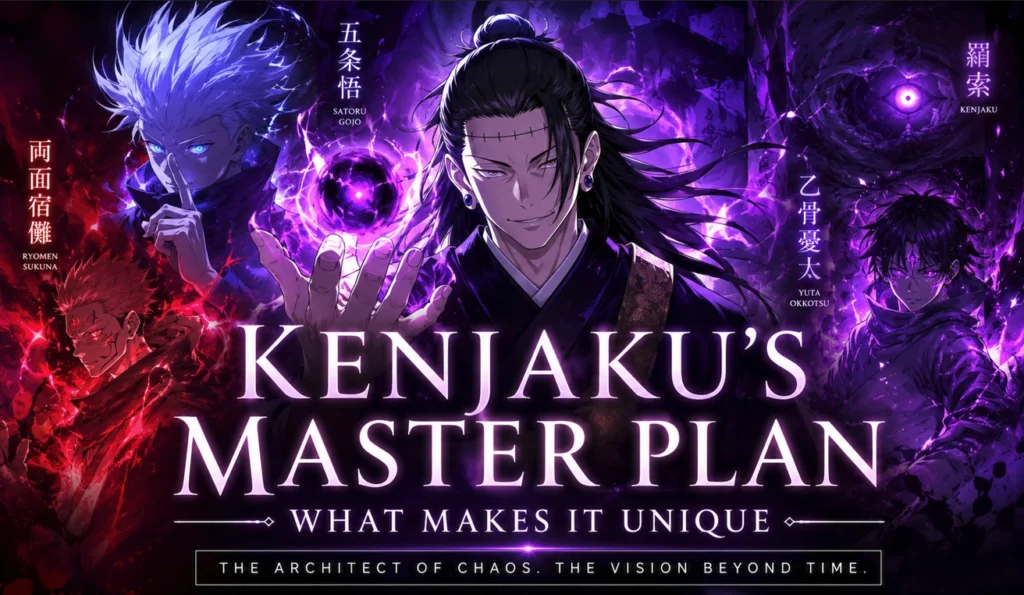
Kenjaku’s master plan is one of the most layered villain schemes in modern shonen, and most fans still haven’t fully unpacked it. Here at Shonen Vortex, we’ve been dissecting every Jujutsu Kaisen chapter since the Shibuya Incident broke our brains, and Kenjaku is the one antagonist whose entire plan only clicks once you trace it backwards from the end. What looks like a collection of power moves is actually a thousand-year obsession with human evolution. As of mid-2026, with Season 4 confirmed and the Culling Game arc incoming, there’s never been a better time to break this down completely.
Table of Contents
- What Exactly Is Kenjaku’s Master Plan?
- The Body-Switching That Started Everything
- Kenjaku’s Role in Setting Up the Culling Game
- The Merger With Tengen: The Real Endgame
- Why Kenjaku’s Plan Stands Apart From Every Other JJK Villain
- What the Manga’s Final Arc Reveals About the Plan
- FAQ
- Verdict
What Exactly Is Kenjaku’s Master Plan?
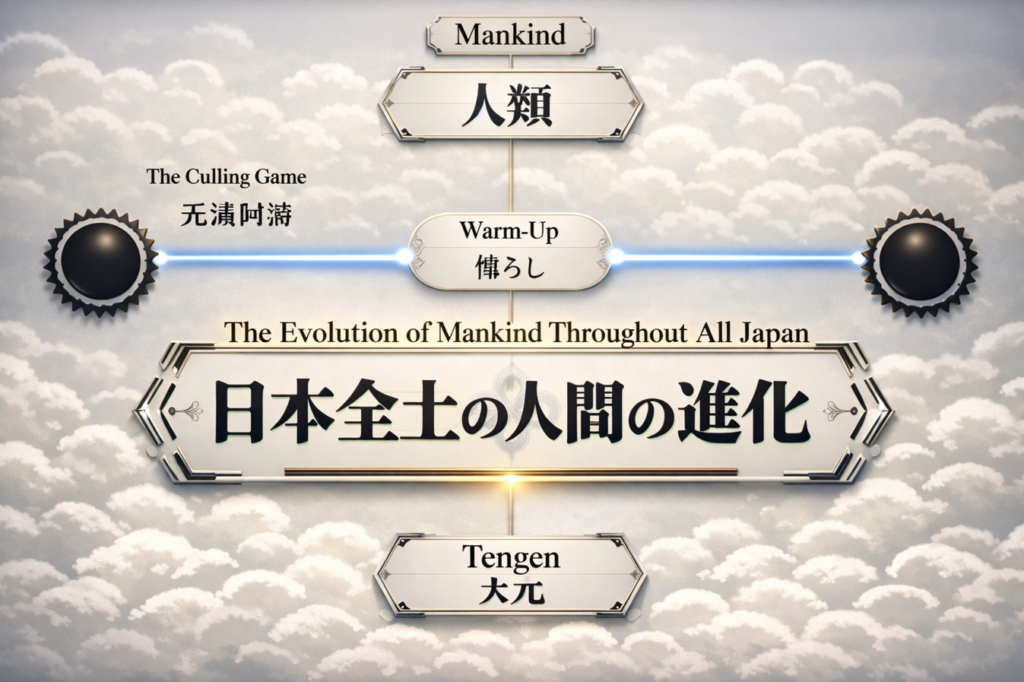
Kenjaku’s master plan is a millennia-spanning scheme to evolve humanity by merging all of Japan’s cursed energy users with the immortal barrier-technique user Tengen, effectively creating a new form of cursed spirit or god-tier entity. That is the short version. The actual execution involves body-hopping across centuries, engineering the birth of Ryomen Sukuna’s reincarnation, and running a death tournament with six billion people as the prize pool.
Key goals of the plan, in order:
- Survive across centuries by transplanting his brain into host bodies
- Manipulate Tengen’s evolution by cutting off the Star Plasma Vessel (Chapter 65)
- Engineer Yuji Itadori’s birth as a vessel for Sukuna’s fingers
- Activate the Culling Game to force cursed energy evolution across Japan
- Merge the Culling Game participants with Tengen to birth a new existence
- Use the resulting entity as a gateway to “The Back Side of the World”
The plan is not about power. It is about what comes after power.
The Body-Switching That Started Everything
Kenjaku’s cursed technique allows him to transplant his brain into another person’s body, inheriting their abilities. This is the foundation everything else is built on.
His most notable host is Suguru Geto, whose body he took after Gojo killed Geto at the end of the Hidden Inventory arc. Per the guardrail: Geto’s soul departed at that point. What walks around in Season 2 onward is Kenjaku wearing Geto’s face. This is confirmed in Chapter 90 when Gojo recognizes that whoever is speaking is not his old friend.
Before Geto, Kenjaku occupied the body of Noritoshi Kamo, a sorcerer from the Meiji era who became infamous for the “Cursed Womb: Death Paintings” experiments. Those nine children, born from a woman he kidnapped and cursed, became Choso and his brothers. Kenjaku engineered them as tools, not as family. Choso’s eventual turn against him is one of the most emotionally earned moments in the manga.
This is what separates Kenjaku from other JJK antagonists: every relationship in his history is a resource.
If you want to understand what he took from Geto specifically, our breakdown on who Kenjaku really is and the truth he’s been hiding goes deep on the body-swap mechanics.
Kenjaku’s Role in Setting Up the Culling Game
Kenjaku’s master plan required a triggering event at scale. That event is the Culling Game.
To understand the rules and how Kenjaku bent them, read our full Culling Game rules breakdown from Season 3 Episode 3.
The Culling Game is technically a Binding Vow. And here is where Akutami’s system gets precise. Per the JJK Official Fanbook, Binding Vows increase the power of a technique proportionally to the weight of the restriction placed. Kenjaku’s vow was this: anyone reincarnated into the Culling Game must participate or lose their cursed technique. That is a coercion engine disguised as a rules framework.
He spent centuries planting “Cursed Womb” souls, colonists dormant inside ordinary Japanese citizens, waiting for activation. The Culling Game woke them all up simultaneously. One thousand colonists, suddenly active, each forced to compete.
Why the Culling Game is uniquely diabolical:
- It selects for the highest-output cursed energy users
- It eliminates weak or undesirable genetic lines
- It creates the maximum density of evolved sorcerers in one location
- It forces survivors into binding vows that concentrate their power
- It functions as both a filter and a battery for the Tengen merger
The Culling Game rules were set by Tengen and then modified by Kenjaku, as confirmed in Chapter 145. This distinction matters. Kenjaku did not create the game from scratch. He hijacked a framework and pointed it toward his own goal.
For context on how Tengen fits into all of this, our article on who Tengen Sama really is in Jujutsu Kaisen is required reading.
The Merger With Tengen: The Real Endgame
Tengen is immortal but not unchanging. Every few centuries, Tengen requires a Star Plasma Vessel to merge with, resetting their form back to human. If the merger does not happen, Tengen evolves past human entirely and becomes a cursed spirit of enormous, uncontrollable power.
Kenjaku’s plan was to prevent that merger twice: once in the Hidden Inventory arc (Chapter 65 to 79), where he sent assassins to kill Riko Amanai before she could merge with Tengen. He succeeded. Tengen remained un-reset, still evolving.
The second step: force a different merger. Instead of one vessel, Kenjaku wanted to merge all of the Culling Game’s evolved participants with Tengen at once. The resulting entity would be something entirely new. Not human, not cursed spirit, not sorcerer. A collective consciousness built from the best cursed energy humanity ever produced.
That entity was the key to accessing “The Back Side of the World,” a dimension or state of existence that Kenjaku describes as the next phase of human evolution. The specifics of what exists there are left deliberately ambiguous by Akutami, which is either brilliant thematic restraint or the most infuriating withhold in shonen depending on who you ask.
This is where Kenjaku stops being a villain with goals you can argue against. He is pursuing something genuinely post-human. That is what makes him different from Mahito (who hates humans), Sukuna (who simply does not care about humans), or the higher-ups (who maintain systems for self-interest).
Speaking of Sukuna, the complete breakdown of Sukuna’s true form and final evolution shows how he fits into the picture separately from Kenjaku’s arc.
Why Kenjaku’s Master Plan Stands Apart From Every Other Jujutsu Kaisen Villain
Re-reading the Hidden Inventory arc with the full manga context, the panel most fans skip is the one where Kenjaku watches Riko Amanai die and smiles. Not because he enjoys cruelty, but because the system worked exactly as intended. That smile is cold in a way Mahito’s cruelty never is, because it is administrative.
Here is a direct comparison of JJK’s major antagonist motivations:
| Villain | Core Motivation | Method | Scope |
|---|---|---|---|
| Sukuna | Personal supremacy, freedom | Direct combat, conquest | Individual |
| Mahito | Philosophical hatred of human souls | Idle Transfiguration experimentation | Small-scale terror |
| The Higher-Ups | Institutional preservation | Political control, assassination | Japan’s jujutsu world |
| Kenjaku | Post-human evolution | Centuries of manipulation | All of humanity |
Kenjaku is operating on a different axis from every other antagonist. For a full ranking of where every Jujutsu Kaisen villain sits on the power and threat scale, see our complete JJK villains ranked list.
What makes Kenjaku’s plan uniquely effective:
- It operates across centuries, so no single generation can fully counter it
- It uses jujutsu’s own institutional structures against themselves
- It converts other people’s goals (Sukuna’s freedom, Yuji’s existence) into fuel
- It builds in redundancy: if one host dies, the brain survives
- It does not require Kenjaku to “win” fights, only to survive long enough
The fandom has compared Kenjaku to Aizen from Bleach. We will say this: Aizen’s plan had a throne at the top. Kenjaku’s plan has a door he wants to open. That is a meaningfully different kind of ambition.
While we’re on Bleach comparisons, our breakdown of Yhwach’s Almighty and Soul King origins shows how a similar “transcend humanity” motivation plays out in a different series.
What the Manga’s Final Arc Reveals About Kenjaku’s Master Plan
Two years after the Jujutsu Kaisen manga ended, the fandom is still split on whether Kenjaku’s plan “succeeded” in any meaningful sense.
The honest answer: partially.
Kenjaku was killed by Takaba and then definitively ended by Yuki Tsukumo, who used her own Binding Vow to create a black hole that destroyed them both (Chapter 243). The Tengen merger did not complete in the way Kenjaku intended. But Kenjaku’s deeper project, the destabilization of the jujutsu world’s power structure and the release of Sukuna’s full form, was already in motion before his death.
The Choso and Yuki versus Kenjaku confrontation is one of the manga’s most emotionally complex fights. Our full breakdown of Choso, Yuki, and Kenjaku’s clash covers every beat of it.
Kenjaku’s death raises a genuinely uncomfortable question for the ending: was his plan the actual final threat, or was he always just the setup act for Sukuna? Akutami’s framing suggests the latter. Kenjaku is the architect who builds the stage. Sukuna is what performs on it.
For the full picture of how the Jujutsu Kaisen power system enables a plan like this to even function, that breakdown is worth reading alongside this one.
The Binding Vows explanation is also essential context for understanding exactly how Kenjaku locked so many players into his game.
FAQs
- What is Kenjaku’s true goal in Jujutsu Kaisen?
Kenjaku’s ultimate goal is to merge Japan’s most evolved cursed energy users with the barrier-technique user Tengen, creating a post-human collective entity capable of accessing “The Back Side of the World.” It is not about personal power, but about forcing the next stage of human evolution, as established across Chapters 145 to 160. - Is Kenjaku the same person as Suguru Geto?
No. Kenjaku transplanted his brain into Geto’s body after Gojo killed Geto at the end of the Hidden Inventory arc. Geto’s soul had already departed. The person wearing Geto’s face from that point is Kenjaku, who inherited Geto’s cursed spirit manipulation technique in the process. - Did Kenjaku’s plan succeed?
Only partially. Kenjaku was killed by Yuki Tsukumo in Chapter 243 before the Tengen merger completed as intended. However, the broader destabilization he engineered, the Culling Game, the release of Sukuna, and the collapse of jujutsu society, continued without him. - Why did Kenjaku prevent Tengen’s merger with the Star Plasma Vessel?
By preventing Riko Amanai from merging with Tengen, Kenjaku ensured Tengen would continue evolving past human limits. This made Tengen a more powerful and more unstable entity, which was a prerequisite for Kenjaku’s intended mass merger with Culling Game participants. - What is Kenjaku’s cursed technique?
Kenjaku’s innate technique allows him to transplant his brain into another person’s body, preserving his consciousness and inheriting the host’s cursed technique. He has used this across multiple bodies over at least a thousand years, as confirmed in Chapter 136.
Verdict
Kenjaku’s master plan works because it is patient in a genre that rewards the explosive. Every other major threat in Jujutsu Kaisen operates in real time. Kenjaku operates across centuries. His plan survived Gojo, survived Yuki, and partially outlasted his own death. That is a different category of threat.
The tragedy is that his goals, evolution, transcendence, breaking the cycle of cursed energy, are not entirely wrong. Just monstrous in execution.
For the full context of what the Culling Game leads into, our Sendai Colony arc and Season 4 breakdown has everything you need before Season 4 drops.
Where does Kenjaku rank for you among shonen villains? Is he top five, or does the partial failure of his plan knock him down? Drop your take in the comments below.