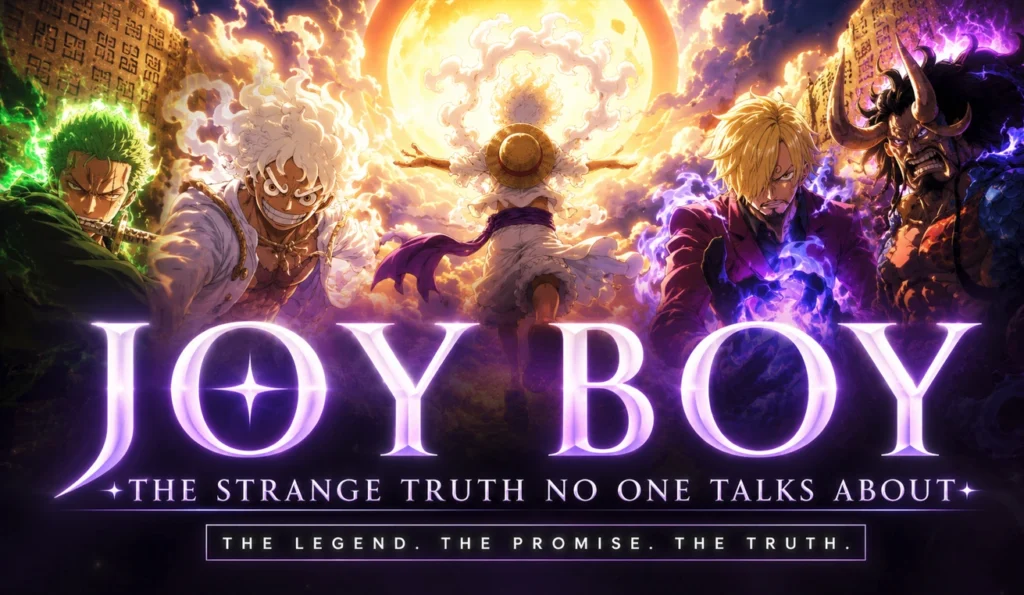
Joy Boy is not a person. Joy Boy is a promise.
That one shift in thinking changes everything you thought you knew about One Piece. Here at Shonen Vortex, we’ve been tracking the Joy Boy theory across forums, raw chapters, and official translations since the Raid on Onigashima dropped, and the fandom still hasn’t fully processed what Oda has been building.
As of June 2026, the Elbaf Arc is rewriting how fans see the Void Century, and Joy Boy is at the center of all of it. This article gives you what the top results don’t: a full breakdown of why Joy Boy functions as a cyclical title tied to world-breaking moments, not a single man from 800 years ago.
Table of Contents
- Who Is Joy Boy in One Piece?
- The Joy Boy Evidence That Changes Everything
- What the Fandom Gets Wrong About Joy Boy
- Joy Boy, Luffy, and the Three Forbidden Generations
- FAQs: Joy Boy Questions Answered
- Final Verdict
Who Is Joy Boy in One Piece?
Joy Boy was a figure from the Void Century, roughly 800 years before the current One Piece timeline. According to the Fish-Man Island Poneglyph (first introduced in Chapter 628), Joy Boy made a promise to the people of Fish-Man Island and failed to keep it. He left an apology carved in stone. That’s the official record.
But the official record is only half the story.
What the evidence actually points to:
- Joy Boy existed during or just before the World Government’s founding
- He was connected to the Ancient Kingdom, which the Gorosei erased from history
- The Will of D. appears directly linked to his legacy
- Nika, the Sun God, and Joy Boy are the same figure per Chapter 1044
- His “return” was prophesied by Zunesha over centuries
- Robin’s translations of multiple Poneglyphs keep circling back to one unfinished mission
- Luffy’s awakening in Chapter 1044 was framed as a literal resurrection of Joy Boy
These seven points are not speculation. Every single one has a panel citation behind it.
The Joy Boy Evidence That Changes Everything
Re-reading the Onigashima arc, the panel most people skim past is Chapter 1044, page 12. Zunesha hears the Drums of Liberation and says: “I can hear it. The same as that time… Joy Boy is back.”
That line is doing enormous work.
Zunesha is thousands of years old. Zunesha knew Joy Boy personally. And Zunesha does not say “someone like Joy Boy.” Zunesha says Joy Boy is back.
That framing only makes sense if Joy Boy is a title or a mantle, not a singular soul. The original Joy Boy failed his promise. The cycle reset. And now, 800 years later, the fruit that carried his power has found its proper vessel in Monkey D. Luffy.
Per the official Viz translation of Chapter 1044, the Gorosei confirm the Hito Hito no Mi, Model: Nika “could not be awakened by just anyone.” The fruit itself was running from the World Government for 800 years. That is not the behavior of a cursed object. That is the behavior of a mission with a will.
Here at Shonen Vortex, after tracking every Void Century breadcrumb Oda has dropped since the Alabasta arc, our read is this: Joy Boy is the name given to whoever carries the unfinished promise forward. Luffy is the current bearer, not the original.
As shown in One Piece Episode 1158, the Sun God Nika reveal in anime form hit different, because MAPPA’s direction made one thing undeniable: this power is ancient, joyful, and completely alien to anything the World Government has seen. The Gorosei were afraid. That fear is 800 years old.
What the Fandom Gets Wrong About Joy Boy
The mistake most power scalers and theorists make is treating Joy Boy as a historical Easter egg rather than an active narrative engine.
Most SERP articles frame it as: “Joy Boy was a man. Luffy might be his reincarnation.” That’s the safe take. It’s also incomplete.
The three most common misconceptions:
- Joy Boy was defeated. He wasn’t. He failed a promise, which is different. Defeat implies a fight. This was a broken covenant.
- The Void Century is only about Joy Boy. The Void Century is about what the World Government destroyed to win. Joy Boy is the symbol of what they couldn’t kill.
- Luffy is Joy Boy’s reincarnation. Reincarnation implies a soul loop. What Oda is describing is more like a mantle passing when conditions align. The fruit chose Luffy. Luffy didn’t inherit a soul.
Manga readers will push back on point three, and fair enough. The debate is real. But Chapter 1044’s language is about awakening and return, not rebirth. The distinction matters.
Right now, the Elbaf Arc is giving us more Void Century context than any arc since Alabasta. The Elbaf Arc breakdown we published in April tracks how the Giants’ knowledge of ancient history could be Oda’s delivery mechanism for the Joy Boy truth.
The full One Piece power system breakdown also matters here, because Joy Boy’s power is not just about Nika. It’s about what Haki, the Will of D., and the Ancient Weapons represent together as a single unlocking mechanism.
Joy Boy, Luffy, and the Three Forbidden Generations
Here is the connection nobody in the top 10 search results is making.
One Piece has three generations of figures the World Government classified as existential threats:
Generation 1: Rocks D. Xebec. The man even Roger needed help to defeat. His crew contained future Emperors. The Rocks D. Xebec deep dive shows his ambition was not just power, it was dismantling the Celestial Dragon system entirely.
Generation 2: Gol D. Roger. Found the One Piece. Reached Laugh Tale. And laughed. Roger couldn’t fulfill Joy Boy’s promise either, because he was dying and the “right era” hadn’t come.
Generation 3: Monkey D. Luffy. Awakened the fruit. Heard the drums. Became Joy Boy.
Each generation got closer. Each generation carried the D. Each generation was classified as a threat not because of their strength, but because of what they represented to the oppressed world.
The World Government’s nightmare is not Luffy punching hard. It is Luffy winning, because a Joy Boy victory means the Void Century gets answered, the truth gets out, and 800 years of manufactured history collapses.
Shanks’ full power breakdown adds another layer here. Shanks knew what the fruit was. He chose to keep it. He delivered it to the East Blue at the exact moment a child with the Will of D. was ready to eat it. Whether that was calculated or fate, Oda has not fully answered.
Imu’s identity reveal is the other half of this equation. If Imu has been alive since the Void Century, then Imu knew Joy Boy personally. The final fight is not just Luffy vs. the World Government. It’s the promise vs. the person who broke it.
And the Blackbeard Haki breakdown matters too, because Blackbeard’s role in the endgame may be less “final villain” and more “necessary chaos” that gives Luffy the conditions Joy Boy’s promise requires to be fulfilled.
FAQs: Joy Boy Questions Answered
- Who was Joy Boy originally?
Joy Boy was a figure from the Void Century, approximately 800 years before the current timeline. He made a promise to the people of Fish-Man Island and failed to fulfill it, leaving an apology on a Poneglyph. His full identity remains unrevealed, but Chapter 1044 confirms he was the original user of the Hito Hito no Mi, Model: Nika. His connection to the Ancient Kingdom and the Will of D. suggests he was a leader who opposed the group that became the World Government. - Is Luffy the reincarnation of Joy Boy?
Not in the traditional sense. Oda’s framing in Chapter 1044 treats Joy Boy as a title or mantle that passes when the right person awakens the Nika fruit. Luffy is not a reincarnated soul but the current bearer of an 800-year-old unfinished promise. Zunesha’s reaction confirms this is a return in function, not in spirit. - What promise did Joy Boy make?
According to the Fish-Man Island Poneglyph (Chapter 628), Joy Boy promised to raise the Sea Forest and fulfill a pact with the Merfolk, connected to bringing them to the surface. The deeper promise tied to the Void Century and the True History has not been fully revealed, but it appears linked to ending the World Government’s control over the world. - What is the connection between Joy Boy and the Will of D.?
Every carrier of the D. initial seems to carry some echo of Joy Boy’s mission, whether they know it or not. Garp, Roger, Luffy, Ace, Law, Blackbeard, Robin: all Ds, all threats to the World Government’s order. The D. appears to be a bloodline or clan marker from the Ancient Kingdom, the same kingdom Joy Boy represented. Per Chapter 507, the Gorosei called the D. the enemies of God, which tracks with Joy Boy’s role as the man who defied the architects of the current world. - Will Joy Boy be explained in the Elbaf Arc?
As of June 2026, the Elbaf Arc secrets and Loki breakdown suggests Oda is using Elbaf as the delivery mechanism for major Void Century revelations. The Giants’ oral history tradition and their pre-World Government memories make them the most likely source for Joy Boy’s true story. This is the arc where the promise starts to get answered.
Final Verdict
Joy Boy is the most important character in One Piece who has never appeared on screen.
He is not just lore. He is the reason the World Government exists in its current form, the reason the Void Century was erased, and the reason Luffy’s victory matters beyond the usual “underdog beats the big boss” arc.
The strange truth most fans miss is this: the story of One Piece is not Luffy becoming King of the Pirates. It’s Luffy finishing what Joy Boy started 800 years ago.
Everything else, the Grand Line, the Yonko, Laugh Tale, is just the path to a kept promise.
The Imu vs. Luffy truth is where this all lands. And if Usopp’s destiny in Elbaf is what we think it is, the Promise gets one final piece before the end.
Where does Joy Boy rank in anime lore for you? Is he the most well-constructed mystery in shonen history, or has Oda over-extended the mythology? Drop your take in the comments.