
Most fans think Luffy just stretches. That’s like saying Gojo just blocks things. Luffy’s powers are one of the most layered, mythology-soaked systems in all of shonen, and the surface read misses almost everything. Here at Shonen Vortex, we’ve been tracking the Nika theory and the Devil Fruit awakening debate since the Wano arc dropped, and the full picture only clicked into place once we mapped each Gear against the Sun God framework.
This breakdown gives you the mechanism, not just the move list. Right now, the fandom is split on whether Gear 5 breaks One Piece’s power scaling or perfects it. We’re settling that today.
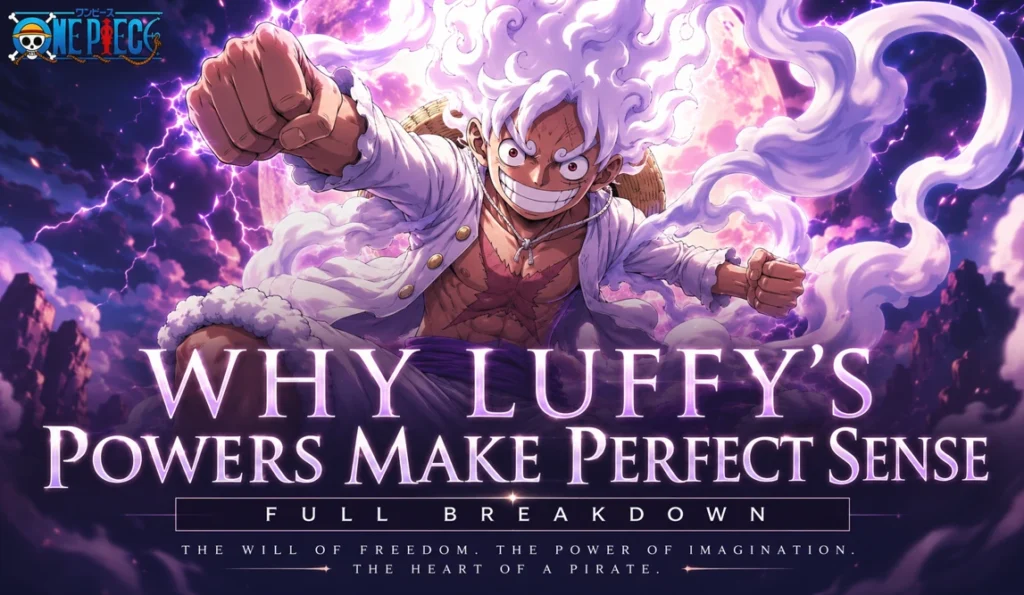
Table of Contents
- What Luffy’s Powers Actually Are
- How Each Gear Works: The Real Mechanism
- Gear 5 and the Sun God Framework
- Why the Rubber Fruit Was Always Special
- FAQs
- Final Verdict
What Are Luffy’s Powers, Really?
Luffy’s powers come from the Gomu Gomu no Mi, now confirmed in Chapter 1044 to actually be the Hito Hito no Mi, Model: Nika, a Mythical Zoan-type Devil Fruit. This is not a Paramecia. It never was.
That distinction matters more than most fans realise.
Paramecia fruits alter the body or environment based on a fixed physical rule. Zoan fruits transform the user by channelling a mythological or animal template. Luffy’s body doesn’t follow rubber physics. It channels the will of the Sun God Nika, a figure in ancient myth described as bringing laughter and freedom by making his body fight like a drum.
That’s the mechanism. Luffy isn’t stretching. He’s manifesting a divine template through his body, and his imagination is literally the limiter.
What This Means for Every Power He Has
- Rubber immunity to blunt force is a property of the Nika myth, not rubber chemistry
- His body’s colour change in Gear 5 reflects a Zoan’s full transformation state
- His cartoon-logic physics in Gear 5 aren’t plot convenience, they’re canon lore
- The “freest fighter in the world” description is written into the fruit’s nature
- Every Gear upgrade is Luffy learning to channel more of Nika’s template
- The World Government spent 800 years hiding this fruit specifically
- Joy Boy, the original user, awakened the same power and still couldn’t complete his mission
The fruit waited. The fruit chose Shanks, who then passed it (accidentally) to Luffy. There’s an argument the fruit had agency. That’s Zoan behaviour.
How Each Gear Works: The Real Mechanism
This is where most explainers stop at “he pumps blood” or “he coats himself in Haki.” We’re going deeper.
Gear 2: Cardiovascular Overdrive
Luffy introduces Gear 2 in Episode 272. The standard read is that he pumps his legs to circulate blood faster, increasing speed and metabolism.
The real mechanism: he’s forcing his rubber cardiovascular system to operate beyond biological limits a normal human body would destroy itself attempting. His Zoan constitution absorbs that stress.
Haki coating in Gear 2 (post-timeskip) means he’s running hardened blood vessels at hyperspeed, which is why attacks like Jet Gatling hit harder than any pre-skip technique despite the same visual animation.
Gear 3: Mass Redistribution
Gear 3 inflates bone marrow, not muscle. Per Episode 336, Luffy bites his thumb and inflates his skeleton directly.
Most breakdowns stop there. The deeper read: inflated bone creates a redistribution of force across a larger surface area on impact, which is why a Gear 3 punch through water (Episode 405) still hurt Luffy despite water being a Devil Fruit weakness. The force per square centimetre dropped, but total kinetic energy stayed massive.
The shrinking side effect pre-timeskip was his body compensating by expelling the air through normal tissue.
Gear 4: Haki Compression and Muscle Inflation Combined
Gear 4 is where the power system gets genuinely sophisticated.
Luffy inflates his muscular system and simultaneously coats it with Armament Haki. This creates a compressed internal pressure. When he releases a strike, the Haki-coated surface rebounds the force outward at a rate faster than direct contact.
This is confirmed mechanically in Episode 726 when Doflamingopoints out Luffy never actually touched him with Boundman hits. The attacks were Haki-channelled air compressions.
Gear 4 has three known modes:
| Mode | Shape | Speed vs Power | Key Trait |
|---|---|---|---|
| Boundman | Inflated, large | Balanced | Standard Gear 4 form |
| Tankman | Maximum inflation | Power dominant | Absorbtion and reflection |
| Snakeman | Compressed, lean | Speed dominant | Python-trajectory punches |
Snakeman’s Python attacks bend mid-flight because Luffy is adjusting Haki pressure distribution after the punch launches. That’s not rubber. That’s advanced Haki application dressed in Zoan mythology.
Gear 5 and the Sun God Framework
Here’s what the top results miss completely.
Gear 5 is not Gear 4 evolved. It’s a category change. Luffy stops amplifying his Paramecia-logic rubber body and fully awakens the Zoan template underneath.
In Chapter 1044, the Gorosei describe the awakening moment as “the drums of liberation.” That phrase is from the Nika mythology directly. The Sun God was said to fight with the “rhythm of liberation” and make his enemies laugh even in defeat.
When Luffy awakens Gear 5 in Episode 1071, his hair, clothes and even the environment around him turn white. That’s full Zoan awakening. Full Zoan transformations in One Piece always reflect the mythological creature’s true domain. Luffy’s domain is pure freedom, which translates physically as the rules stop applying.
Why Gear 5 Physics Break Logically, Not Randomly
Gear 5 Luffy inflated the giant Kaido. He pulled lightning down and ate it. He treated his own heartbeat as a cartoon sound effect.
These look random. They’re not.
The Nika myth specifies that the Sun God’s power was limited only by the joyful imagination of the user. Oda wrote this constraint into the awakening before the reveal. Every Gear 5 moment is Luffy’s subconscious imagination becoming physical reality, filtered through the Nika template.
This is also why Kaido stated in Chapter 1049 that the world’s fate depends not on strength but on the will to keep going. He recognised that Luffy’s power was never about physical output. It was about the ideological permission structure of the Nika fruit.
For how this connects to One Piece’s broader power system, check out our full breakdown of the One Piece power system’s deepest secrets.
Why the Rubber Fruit Was Always Special
The World Government renamed this fruit and hunted it for 800 years. That detail is the receipt most fans skip.
They didn’t hunt Ace’s Mera Mera no Mi. They didn’t pursue the Gura Gura no Mi before Whitebeard. But they specifically suppressed the Nika fruit’s name, kept it off the Devil Fruit encyclopedia, and had CP agents embedded to track it.
Because a Paramecia that just makes you stretchy doesn’t scare an immortal government.
A Mythical Zoan tied to a god of liberation who defeated the World Government’s ancestors 800 years ago, held by someone whose will cannot be broken? That does.
Joy Boy was the original Nika awakener. He made a promise to Fishman Island he couldn’t keep. The fruit has been waiting, as Zunesha describes it (Chapter 1044), for someone whose personality matches the Nika template completely.
Luffy’s laugh is literally written into the myth. “Nika” is described in ancient One Piece lore as the source of smiles. Luffy’s signature “shishishi” laugh isn’t a character quirk. It’s a prophecy marker Oda planted in chapter 1.
This also reframes the Shanks and the Elbaf arc entirely. Shanks didn’t just eat the fruit as a child. He was the last known holder of a weapon the World Government was trying to contain. And he gave it up.
How Haki Layers Into Luffy’s powers
Luffy’s Haki development follows the same three-part structure as his Gears: observation, armament, then conqueror’s. Each one unlocked at a narrative turning point, not arbitrarily.
Conqueror’s Haki coating, revealed in the Kaido fight, is the capstone. Most fighters can’t even apply it externally. Luffy figured it out mid-battle by watching Kaido’s technique.
For a full breakdown of how Haki works in the One Piece world, our complete Haki guide has the tier-by-tier mechanics.
The key point here: Conqueror’s Haki coating works because Luffy’s Nika template has no natural ceiling on Haki output. The fruit’s nature amplifies the user’s spiritual force, which is why the Gorosei said even they couldn’t predict the awakening’s upper limit.
This is also directly comparable to the Shanks power breakdown where Conqueror’s Haki manifests differently based on the user’s will structure.
The Imu Problem and Where Luffy’s Powers Are Going
Right now, trending across the fandom is the question of how Luffy’s powers match up against Imu, whose identity is now partially revealed.
Imu appears to have a fruit that manipulates erasure, literally deleting things from existence. The contrast with Nika, a fruit that creates through imagination, is not accidental.
Oda set up a final boss whose power is the literal opposite of Luffy’s. Deletion versus creation. Fear versus joy. 800 years of suppression versus 800 years of waiting.
The Imu vs Luffy matchup breakdown covers the specifics, but the power system logic points toward a final confrontation where Luffy’s imagination is the only counter to Imu’s erasure.
That’s not power scaling. That’s mythology completing its loop.
FAQs
- What type of Devil Fruit does Luffy actually have?
Luffy’s fruit is the Hito Hito no Mi, Model: Nika, a Mythical Zoan confirmed in Chapter 1044. Despite appearing to function like a Paramecia for most of the series, it’s a Zoan tied to the Sun God Nika. The World Government disguised its true name in Devil Fruit records to suppress its discovery. - Why does Luffy turn white in Gear 5?
The white transformation reflects full Zoan awakening. When a Mythical Zoan fully awakens, the user takes on the visual and physical traits of the mythological template. In Nika’s case, this means white colouring associated with the sun deity, and physics that bend to the user’s imagination and joyful intent. - How does Gear 5 not break the power system?
Gear 5 has a defined limiter: Luffy’s stamina and the Nika awakening’s toll on his body. After using it against Kaido, he was heavily exhausted. The power is boundless in theory, but Luffy’s physical reserves cap it. This is consistent with every Gear having an activation cost. - Can Luffy beat Imu?
Based on current lore, the Nika fruit’s power of creation and freedom is the narrative counterforce to Imu’s apparent erasure ability. Whether that translates to a clean win depends on Luffy’s mastery level when they meet. The Imu identity breakdown covers what we know about Imu’s power. - What is the connection between Luffy and Joy Boy?
Joy Boy was the original awakener of the Nika fruit 800 years ago. He made a promise to Fishman Island he couldn’t fulfil and left a Poneglyph apologising. Zunesha confirmed in Chapter 1044 that Luffy becoming Joy Boy was the moment the drums of liberation sounded again. Luffy isn’t Joy Boy reincarnated. He’s the person the fruit and the prophecy were waiting for.
Final Verdict
Luffy’s powers are not rubber physics with upgrades.
They are a Zoan mythology system that Oda laid the groundwork for in chapter 1, built through 1000+ chapters, and executed in a reveal that reframed the entire series.
Every Gear is a stage of channelling the Nika template. Every Haki advancement is Luffy’s will catching up to the fruit’s potential. Gear 5 is not the ceiling. It’s the awakening of the floor.
The fandom is still arguing about whether it’s earned. We think the argument settles the moment you map it back to the Sun God framework.
Manga readers who’ve seen where the Elbaf arc is pointing know the power evolution isn’t done.
Where does Gear 5 sit in your personal shonen power scaling? Is it the most creative awakening ever written, or did Oda go too far? Drop your take in the comments.
Hi to every body, it’s my first visit of this
blog; this blog carries remarkable and genuinely fine data for
readers.
Thank you!
Does your website have a contact page? I’m having problems locating it but, I’d like to shoot you an email.
I’ve got some ideas for your blog you might be interested
in hearing. Either way, great website and I look forward to seeing it grow over time.
Will add one in sometime.
However you can mail us at admin@shonenvortex.com
Do you have any video of that? I’d want to find out some additional information.
This is completely my own idea, though I’m not sure if anyone else has made a video on it yet. I haven’t dabbled much in video creation myself.