
Introduction
The Sakamoto Days power system is quietly one of the smartest setups in modern shonen, and most breakdowns are only scratching the surface. Here at Shonen Vortex, we have been tracking this series since the manga’s debut run in Weekly Shonen Jump, and the anime’s explosive 2025 arrival confirmed what manga readers already knew: this system rewards brains over raw power in a way almost no other shonen does. What you will find here is a full breakdown of how the system actually works, why it creates such unusual fights, and a tier matrix no one else has compiled. As of June 2026, the fandom is still sleeping on the mechanics that make Sakamoto himself so terrifying.
Table of Contents
- What Is the Sakamoto Days Power System?
- The Core Mechanics That Drive Every Fight
- Killing Intent: The Hidden Engine
- Sakamoto Days Power Tier Breakdown
- How Sakamoto Stacks Up Against Other Shonen Protagonists
- FAQs: Sakamoto Days Power System
- Final Verdict
What Is the Sakamoto Days Power System?
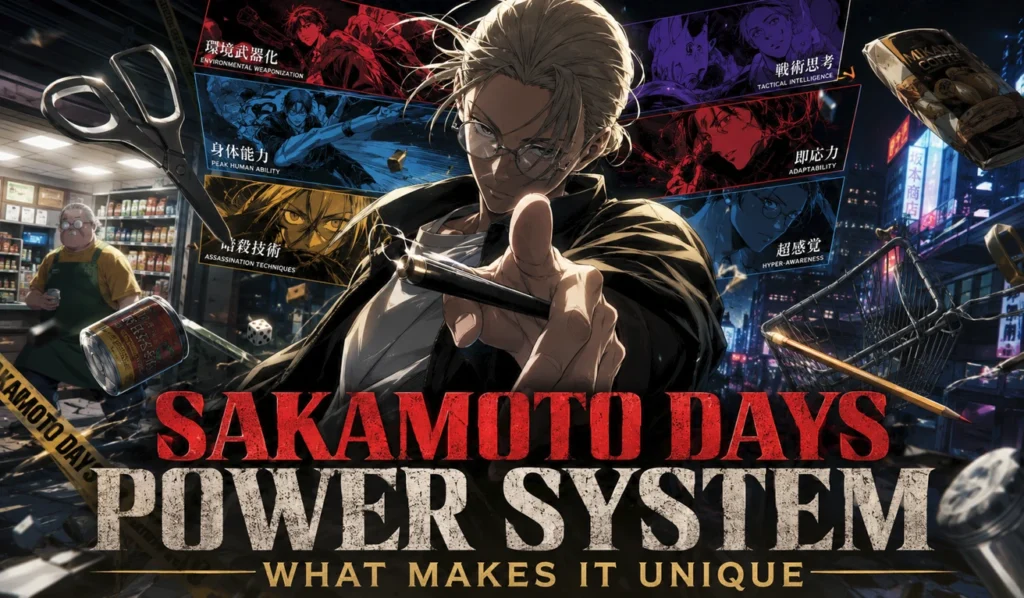
The Sakamoto Days power system is a skill-based combat framework built around ESP (Extrasensory Perception), physical conditioning, and tactical improvisation. It has no magic meter, no chakra, no Devil Fruit logic. Strength is earned through discipline, training, and exploiting opponents’ psychological tells. That simplicity is exactly what makes it dangerous.
Core pillars of the system:
- ESP: telepathy, precognition, and emotional reading
- Superhuman physical conditioning (speed, strength, reflexes honed by years of assassination work)
- Weapon proficiency across improvised and conventional tools
- Tactical IQ: reading environments and manufacturing advantages
- Killing intent: the aura assassins project and read in combat
- Weakness exploitation through psychological warfare
- Teamwork multipliers, particularly the Sakamoto-Shin dynamic
The Core Mechanics That Drive Every Fight
Most shonen systems ask: who has more power? Sakamoto Days asks: who understands the fight better?
Physical stats matter. But the system’s real engine is information asymmetry. Characters who can read killing intent gain a massive edge. Characters who can suppress it become nearly undetectable threats.
Shin Aiba’s telepathy is the clearest example. As shown in the early chapters, Shin can read surface thoughts and project information directly to Sakamoto mid-fight. That creates a two-man unit that functionally operates like a single entity with perfect communication. No other duo in the series replicates this.
Re-reading the early assassination arcs, the detail most people skip is how consistently Sakamoto wins not by overpowering opponents but by denying them the psychological framework they rely on. He suppresses his own killing intent so completely that trained assassins cannot predict his attacks. Chapter 1 establishes this immediately: the hitmen sent to kill him cannot read his intent at all, and they die for it.
Per the manga’s established lore (Shueisha, Weekly Shonen Jump, 2020 onward), the JAA (Japan Assassins Association) ranking system loosely maps to this framework, with S-rank and above representing assassins whose ESP or physical conditioning has reached a level that breaks normal combat logic.
Killing Intent: The Hidden Engine
This is where the Sakamoto Days power system separates from every comparable series.
Killing intent in most shonen is flavor. A visual effect. A vibe. Here it is a combat mechanic with counters.
Trained assassins broadcast killing intent involuntarily. Opponents read it and react. The higher the skill level, the more refined this broadcast becomes, until elite fighters are essentially telegraphing their moves to anyone sensitive enough to receive them.
Sakamoto breaks this loop. His decades of conditioning have allowed him to operate with near-zero killing intent even while executing lethal strikes. The result: opponents who have spent careers reading intent suddenly cannot process what he is doing. Their instincts give them nothing. They hesitate. He does not.
Trending across fan forums this week, the debate around whether Sakamoto’s intent suppression is a learned skill or something innate is heating up, especially with recent manga chapters pushing deeper into his past. Our read: it is learned. The flashbacks in the Nagumo arc support this, showing a younger Sakamoto who was readable before refining his technique.
Sakamoto Days Power Tier Breakdown
The mistake most power scalers make with this series is ranking characters on physical stats alone. The tier system below weighs ESP access, killing intent control, and tactical IQ alongside raw power.
| Tier | Characters | Why They Rank Here |
|---|---|---|
| S | Sakamoto, Slur, Nagumo | Unreadable intent, elite ESP or conditioning, system-breaking tactics |
| A | Shin Aiba, Osaragi, Boaroboaro | High ESP or peak physical conditioning, reliable in solo combat |
| B | Lu Xiaotang, Heisuke Mashimo | Strong specialized skills, consistent mid-fight adaptation |
| C | Rookie JAA members, early arc opponents | Competent but readable, rely on standard assassin training |
Sakamoto sits alone at the top of S-tier not because he is the physically strongest character in the series but because his intent suppression combined with his peak physical conditioning makes him effectively impossible to predict through the system’s dominant sensing mechanic.
Slur’s placement reflects what Chapter 100+ reveals about their combat capability: a level of ESP and physical output that exceeds any single JAA ranking category.
How Sakamoto Stacks Up Against Other Shonen Protagonists
This is a question the fandom keeps circling, and it is worth addressing directly.
If you have been following our breakdown of how Gojo’s Infinity works or our comparison of Haki vs Cursed Energy, you already know that shonen power systems reward different things. Gojo’s system rewards conceptual domination. The One Piece power system rewards mastery of layered mechanics. JJK’s cursed techniques reward creativity under binding rule sets.
Sakamoto Days rewards adaptability above everything.
Sakamoto has no cursed technique. No Devil Fruit. No Nen category. What he has is a mind that processes combat faster than opponents can act and a body that was built for killing over decades of professional work. Against a system like Jujutsu Kaisen’s domain expansions, he loses to the ceiling. Against the average opponent in his own universe, almost no one can touch him.
The series’ closest structural sibling is probably Assassination Classroom, but where Koro-sensei’s power is designed to be untouchable until it is not, Sakamoto’s power is presented as earned and vulnerable. He gets hit. He loses weight. He bleeds. That vulnerability is what keeps the fights tense even when the outcome feels obvious.
Manga readers will fight us on this, but the weight mechanic is underrated as a storytelling device. It is the series’ built-in nerf that maintains stakes without retconning Sakamoto’s established capability.
FAQs: Sakamoto Days Power System
- What is the main power system in Sakamoto Days?
The Sakamoto Days power system centers on physical conditioning, ESP abilities like telepathy and precognition, and killing intent control. Unlike most shonen, it has no energy meter or magic system. Combat advantage comes from information superiority, psychological manipulation, and tactical IQ applied in real time. - Is ESP in Sakamoto Days like psychic powers in other anime?
Partially. ESP in Sakamoto Days functions more narrowly than in series like Mob Psycho 100. It primarily covers telepathy, intent reading, and limited precognition rather than large-scale telekinesis or elemental control. Its combat application is primarily informational rather than offensive. - Why is Sakamoto so powerful if he is just a regular person?
Sakamoto is not a regular person. He is the former world’s greatest assassin who spent decades conditioning his body and suppressing his killing intent to a level no other character in the series demonstrates. His power is the product of discipline and experience, not a supernatural gift. - Does the weight gain affect Sakamoto’s power level?
Yes, and this is confirmed throughout the manga. His post-retirement weight directly reduces his peak speed and agility. Several fights show opponents landing hits on him that would have been impossible before the retirement arc. It is a genuine physical limitation, not just visual gag. - How does Shin’s telepathy work with Sakamoto’s fighting style?
Shin reads opponents’ surface thoughts and relays tactical information to Sakamoto in real time. This effectively gives Sakamoto a heads-up display during combat. Combined with Sakamoto’s intent suppression, the pair create a one-sided information exchange where Sakamoto receives opponent data while broadcasting nothing in return.
Final Verdict
The Sakamoto Days power system works because it is honest. Every advantage has a counter. Every ability has a ceiling. Sakamoto is not unbeatable; he is just harder to beat than anyone else in his universe because he understands the system’s rules better than his opponents.
The killing intent mechanic is the piece most breakdowns miss entirely. Once you understand it, every fight in the series reads differently.
The series is building toward power level conflicts that will test exactly how far physical conditioning and tactical IQ can go against characters whose ESP approaches something closer to precognition. That ceiling fight is coming. We cannot wait to break it down when it lands.
Where does Sakamoto rank in your personal shonen protagonist tier list? Drop your take in the comments, especially if you think the weight nerf is fair game or just narrative convenience.