Introduction
Every few seasons a power system comes along that actually makes you stop and think instead of just watching numbers go up. Daemons of the Shadow Realm is that show right now. Here at Shonen Vortex, we’ve been tracking this series since the Studio Bones premiere in April, and the deeper you look at the Seal and Break mechanics, the weirder and smarter this world gets. This isn’t a retread of the usual shonen power fantasy. As of August 2026, the fandom is still arguing over how much of the mythology is hiding in plain sight, and we want to break down exactly what’s going on, the same way we did with the Jujutsu Kaisen power system and the One Piece power system.
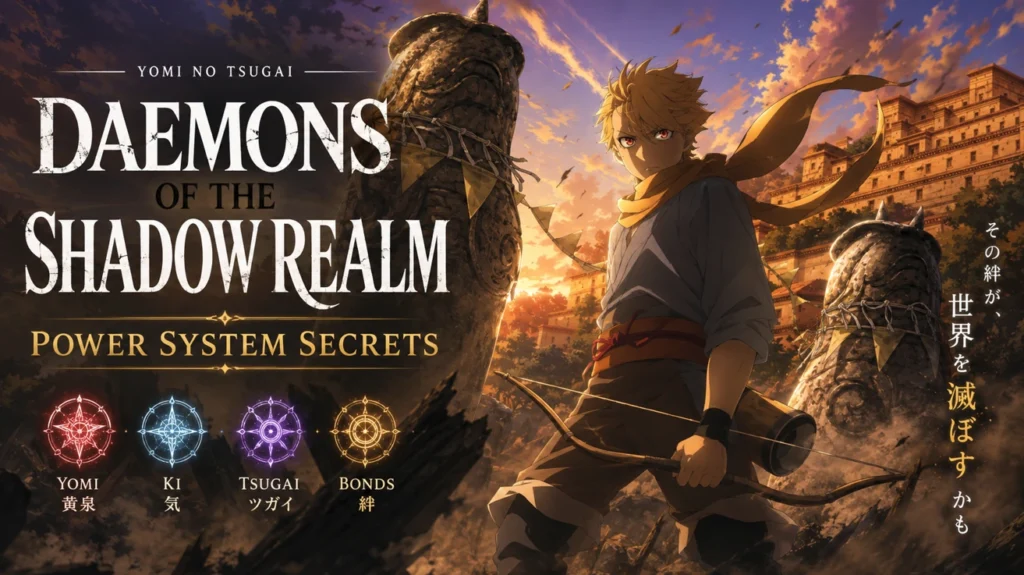
What this article gets right that most breakdowns miss: the Seal/Break split isn’t just a gimmick, it’s built directly on Shinto death mythology, and reading it that way changes how you predict the endgame.
Jump to:
- What Is the Daemons of the Shadow Realm Power System?
- How Daemon Pairs Actually Work
- Seal vs Break: The Twin Mechanic Explained
- The Kagemori Clan’s Daemons, Ranked
- Where the Mythology Comes From
- FAQs
What Is the Daemons of the Shadow Realm Power System?
The power system in Daemons of the Shadow Realm revolves around Daemons, supernatural beings that always bond to their human user in pairs rather than alone. Each pair splits a single ability between two bodies, which means strategy in this show is about coordination, not raw output. It’s a sharper idea than it sounds, and it’s part of why fans comparing it to how Gojo Infinity works keep coming back to it.
Quick facts on the system:
- Daemons bond to humans in pairs, never solo
- Twins Yuru and Asa are prophesied to control all Daemons
- guru’s side of the bloodline governs Seal
- Asa’s side governs Break
- Guardian Daemons Left and Right have protected guru’s village for generations
- The Kagemori clan fields multiple Daemon pairs, including the Monster Parade
- Newer pairs like Blacklist extract information rather than fight directly
- The series is written by Hiromu Arakawa, the creator of Fullmetal Alchemist
If you’re new to power systems like this, it’s worth comparing it against something like Sakamoto Days’ power system or Kagurabachi’s power system to see how differently mangaka approach the same basic idea of “bonded power.”
How Daemon Pairs Actually Work
Re-watching this arc, the detail most people skip is that a Daemon pair isn’t two separate powers stapled together. It’s one ability, mechanically split across two entities. That’s a very different design philosophy from something like a cursed technique in Jujutsu Kaisen or a Devil Fruit in the One Piece Devil Fruits ranked guide, where one user typically holds the whole toolkit.
Take Left and Right, guru’s guardian pair. One handles offense, the other handles utility and tracking. Neither functions at full strength alone, which is the same design tension you see when comparing dual-wielders across shonen, similar to how fans debate Asta vs Yuno in Black Clover or how Maki Zenin’s Heavenly Restriction forces a different kind of tradeoff.
The newest pair introduced, Blacklist, breaks that offensive mold entirely. One half is a set of oversized hands built for restraint, the other is a living book that extracts information from whoever gets grabbed. It’s less about damage and more about control, closer in spirit to a support-oriented Daemon than a brawler, and it’s already splitting fan opinion the way Hakari’s Idle Death Gamble did when it first dropped.
Seal vs Break: The Twin Mechanic Explained
| Mechanic | Bearer | Function | Best Comparison Point |
|---|---|---|---|
| Seal (封) | Yuru | Locks a Daemon’s power or presence away | Similar restraint logic to a binding vow in Jujutsu Kaisen |
| Break | Asa | Forces a Daemon or bond open | Closer to unlocking a dormant ability, the way Reverse Cursed Technique reverses standard flow |
Seal and Break aren’t just twin gimmicks, they’re opposite halves of the same underworld logic. Episode 16 leans directly into this by putting Yuru through a forced brush with death to trigger a Seal, and it’s the clearest sign yet that the show is building toward Yuru and Asa needing each other’s half of the mechanic to finish the prophecy. That kind of “opposite twins, one whole power” structure has fans drawing lines to Kenjaku’s master plan in how patiently the setup pays off.
Was this a twist, or was it foreshadowed from episode one? Manga readers keep telling us it’s the second one, and honestly, they’re right.
The Kagemori Clan’s Daemons, Ranked
The Kagemori clan is the show’s other major power center, and it’s worth ranking their known Daemon pairs the same way we ranked every JJK domain expansion or the strongest Black Clover characters:
- Gonzo’s Monster Parade (Centimanus and Uyamuya) — the clan head’s own pair, and the most overtly threatening Daemon combo shown so far
- Asuma Kagemori’s Yozakura and Asagiri — less flashy, more unsettling, built around misdirection
- Hikaru Kagemori’s unnamed pair — still developing on screen, watch this space
None of these are confirmed as the strongest Daemons in the full cast yet, the same way every Yonko in One Piece took years to fully rank. But the clan’s structure alone tells you this world runs on inherited power, not raw individual talent, which lines up with how the Zenin clan functions across the JJK cast.
Where the Mythology Comes From
This is the section most other breakdowns skip entirely, and it’s the real information gain here. The Japanese title, Yomi no Tsugai, points straight at Yomi, the Shinto underworld described in the Kojiki. Yomi isn’t a punishment realm, it’s where everyone ends up regardless of how they lived, and its entrance was sealed shut by the god Izanagi after he fled the decomposing body of his wife Izanami.
That sealing is the mythological root of Seal as a mechanic. Once you see it, you can’t unsee it, the same way once you understand Haki in One Piece you start noticing it in every fight scene. Arakawa buried this connection in the title back when the manga started in Monthly Shonen Gangan, years before the anime ever aired.
Trending across the fandom this week: theory threads connecting Asa’s “duty” inside the cage to a ritual role tied directly to Yomi, not just a punishment for being born second. If that holds up, it reframes everything about why the twins were separated in the first place.
Compared to how Bleach built its Soul King mythology or how Demon Slayer’s Sun Breathing ties back into in-universe history, this is one of the more disciplined uses of real-world mythology in a currently airing shonen.
FAQs
- What is the power system called in Daemons of the Shadow Realm?
There’s no single named system. Powers come from bonded pairs of Daemons, split mechanically between guru’s Seal ability and Asa’s Break ability, with each twin governing one half of the family’s inherited power. - Are Yuru and Asa the strongest characters?
Not yet confirmed. They’re prophesied to control all Daemons, but as of Episode 16 the Kagemori clan and its Daemon pairs remain a serious unknown threat. - Who created Daemons of the Shadow Realm?
Hiromu Arakawa, the creator of Fullmetal Alchemist, writes the original manga, which has been serialized in Square Enix’s Monthly Shonen Gangan since December 2021. - What studio animates the anime?
Studio Bones Film, which premiered the series on April 4, 2026, and it currently streams on Crunchyroll and Netflix. - Do Daemons ever work alone?
No. Every confirmed Daemon in the series operates as part of a bonded pair, which is the core rule of the entire power system.
Final Verdict
The Daemons power system earns its hype because it isn’t decoration. Seal and Break are two halves of a mythological idea Arakawa planted in the title from day one, and the Kagemori clan gives the show a second power axis to pay off later. This is shaping up to be one of 2026’s most quietly ambitious power systems, right up there with how deliberately One Piece built the Ancient Weapons mystery.
Where do you rank the Daemons of the Shadow Realm power system against the rest of this season? Drop your tier list in the comments.